
Effective bundling: Pain points and expectations from subscription leaders
Introduction and Study Methodology
The subscription landscape is growing increasingly complex, with consumers embracing more subscription services than ever across entertainment, retail, fitness, transportation, and other areas of their lives.
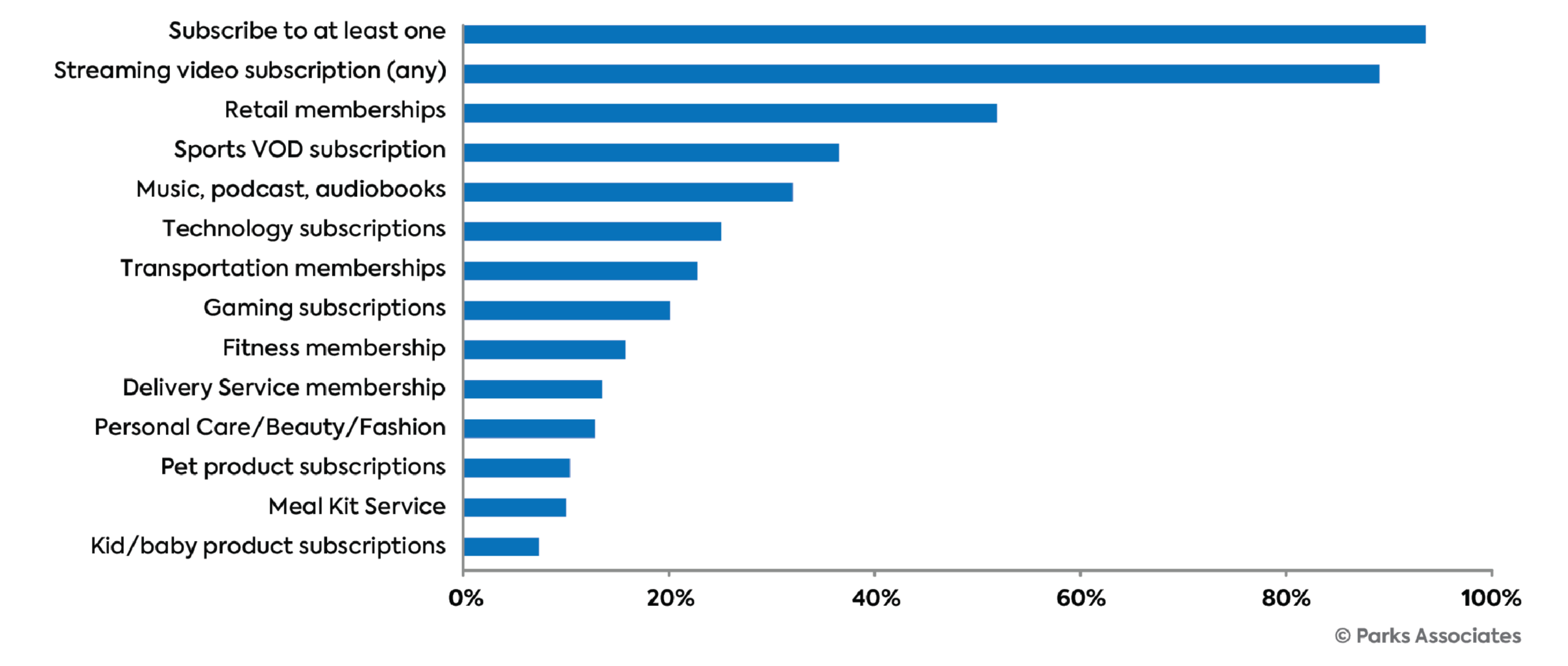
Parks Associates research finds that 94% of consumers in US internet households have at least one subscription service across 12 tested categories. Within this, over half of US internet households now subscribe to four or more streaming video services, and 29% report subscribing to over eight video services. Subscription service discovery is increasingly a challenge for companies and for consumers, as is product differentiation. To resolve these challenges, subscription services are looking to new partnerships and promotions, including with telcos – mobile and internet service providers – as well as a number of other players including banks, retailers and tech platforms.
“The goal of bundling and partnerships is to optimize the monetization of content – get it on as many distribution channels as you can… These partnerships are good for business, they’re actively being pursued… [they are] revenue drivers and have built [our] customer base.”
Senior Product Lead, Streaming Video Service
In partnership with Bango, Parks Associates interviewed executives of leading subscription service providers across the streaming video, music, education, and productivity markets to assess the effectiveness of bundling strategies to extend distribution. These interviews uncovered stories of both effective and ineffective partnerships as subscription services tackle the challenge of growing bundle and partnership complexity. This whitepaper shares findings from this custom research, identifies subscription companies’ expectations and best practices for partnerships, and lays a path to proactively identify and avoid pain points.
Study Methodology
This white paper draws on the results of 10 interviews with executives representing leading subscription companies across the streaming video, streaming music, health and fitness, educational services, and productivity services markets. Job titles included: CEO, Senior VP of Audience Engagement and Growth, VP of Business Development, VP of Marketing, Senior Director of Partner Business, Director of Business Development – Telco Partnerships, Global Head of Business Development and Partnerships, Head of Subscription Partnerships, Head of Consumer Brand Partnerships, Senior Product Lead.
Increased Market Fragmentation Brings Growing Subscription Fatigue
Parks Associates has identified over 300 video subscription services in the US market alone, far beyond the ability of the average consumer to sort through and evaluate.
Consumer adoption of subscription services is booming. The Parks Associates study Subscription Memberships and Bundling: Shopping, Video, Gaming, Mobile finds that 94% of US internet households subscribe to at least one of 12 tested subscription types – with streaming video by far the most popular. The average US internet household has more than five streaming video subscriptions.
Consumer Adoption of Subscription Services
With continued inflation putting pressure on household finances, consumers are taking a second look at their spending – reevaluating the benefits that their subscriptions offer. Consumer-reported churn for streaming video services has been steadily rising post-pandemic, with an all-time high of 50% of US internet households reporting cancelling at least one streaming video service in late 2023. When Parks Associates asked why these consumers were churning, the number one reported reason was needing to cut household expenses.
In this increasingly competitive and fragmented market, subscription service providers must face this growing challenge of subscription fatigue, the new realities of high customer acquisition and retention costs, and the need for international expansion and market penetration – while differentiating themselves from their peers. This requires new strategies. This requires partnerships.
Subscription Companies Seek Partners for Bundling and Customer Acquisition
Partnerships are increasingly driving customer acquisition and retention strategies for subscription services. They reduce customer churn, remove friction from the user sign-up process, and enhance brand awareness and market reach. Telco partnerships in particular serve as a valuable method of both opening up new international markets and targeting new segments of consumers within current markets.
Leading executives of subscription companies across industries report success through these initiatives, aligning themselves with a variety of partners across different markets. Executives in the subscription music and video markets share that historically, bundling has driven 15-20% of their services’ user acquisitions.
“Our team was seen as valuable, a revenue driver to P&L. The early growth in subscription services, we saw 20% of that come from partnerships. This was the case for the first year for us. As we gained brand recognition, did marketing on our platform, that percentage started to dip. But it was still in the 10% range. The idea was that we’d partner, interface with these companies that people already had a relationship with, and that this could supercharge our growth.”
Head of Subscription Partnerships, Streaming Video Service
Bundles take several forms:
- Hard bundle: bundle included with a first-party offer and available for free to end user; these offers have high take rates when properly promoted
- Soft bundle: a free or paid optional add-on offer for the partner’s customers, the offer receives priority placement in sales flow; the customer can potentially choose between several options. This includes extended free trials, commonly offered through customer rewards programs.
- Super bundling: the partner acts as content hub and unified billing platform for multiple services, enhancing service discoverability and reducing payment friction
“[Our] early subscription growth was fueled by partnerships. You break into the market through these partnerships. People knew [our company], but not [yet] as a subscription service.”
Head of Subscription Partnerships, Streaming Video Service
“Strategically, we used [partnerships with telcos] to amplify a launch in a new country. We originally launched in a few countries, and then went to 95. This magnified our marketing dollars and let us leverage the telco for localized messaging and creatives.”
Head of Subscription Partnerships, Streaming Video Service
“[Partnerships] are important for multiple reasons: to drive new users, generate new subscribers, to elevate our brand, and make us more recognizable to users.”
Global Head of Business Development and Partnerships, Education Company
Executives report that bundling and partnerships offer numerous benefits to their partners as well: increasing customer satisfaction as measured by net promoter score (NPS), lowering churn, and allowing these companies to differentiate themselves more easily from their peers. Many types of companies are engaging in partnerships with subscription services, such as telcos – including both mobile and residential internet providers – as well as retailers and hardware OEMs, financial institutions, and tech ecosystems, among others.
Study participants have found that any type of partner can be a compelling fit – so long as content is aligned. However, telcos – including both home internet and mobile providers – are a natural content fit for many service types and offerings, have a wide reach, an already established recurring billing relationship, large marketing budgets, a need for differentiation from their peers, and are widely trusted by consumers.
“The value of telcos – you can tap into their user base, which is in the millions and is already used to paying on a monthly basis. They have valid forms of payment and are more comfortable with digital payments – and in many countries, customers trust their telco as the arbiter of services they should be considering.”
Head of Global Business Development and Partnerships, Education Company
“It felt like telcos were the best channel for music streaming. Everyone used a [music] service on their phones, and it made the product offering from a telco stronger and decreased [the telco’s] churn. This is basically what you should do for your strategy.”
CEO, Streaming Music Service
Bundled Services Increases Customer Satisfaction
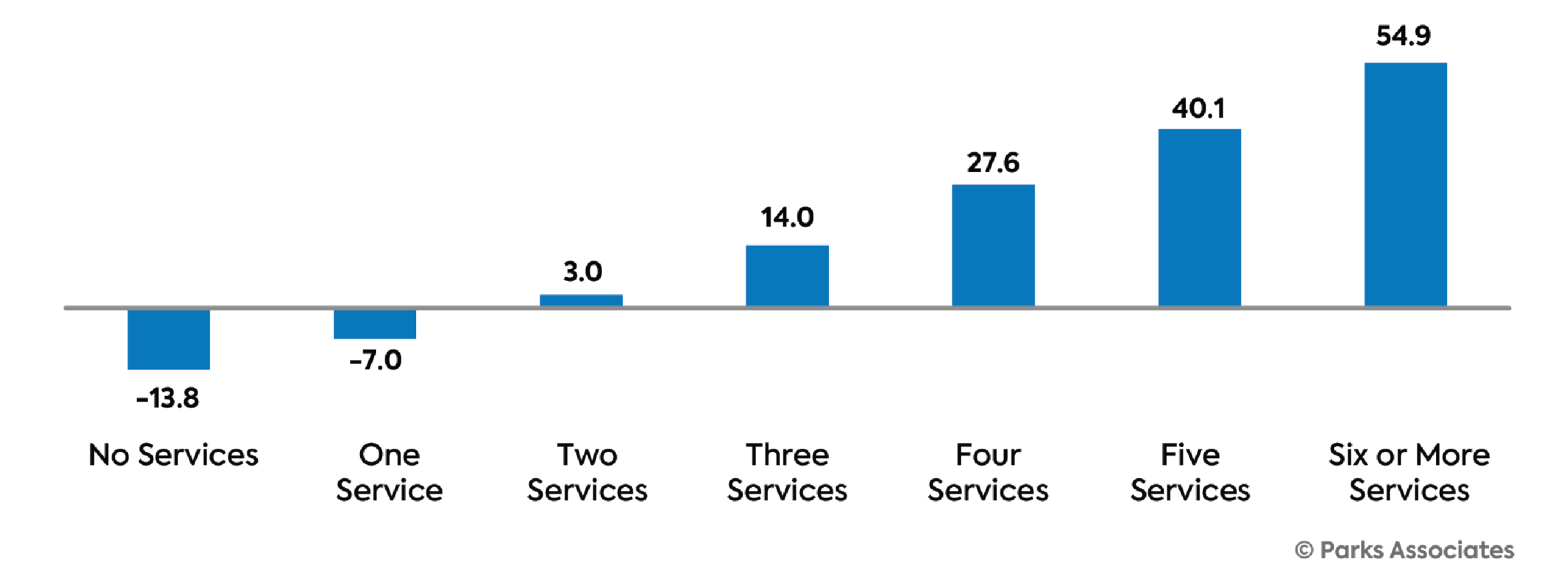
Parks Associates consumer research Home Internet Evolution: 5G and Value-Added Services finds a 22 point lift in home internet provider NPS associated with bundled streaming video subscriptions alongside home internet service. Customer NPS is highly correlated with the number of bundled services they receive from their ISPs, with those receiving a total of six or more additional services of some sort reporting an average NPS of 55.
NPS of Home Internet Provider by Number of Bundles Services
Best Practices to Maximize Partnerships and Avoid Pain Points
Bundles and promotions offer a multitude of benefits to both subscription companies and their partners. They also pose risks, requiring sometimes substantial investments. The success of bundling efforts rests on content alignment and clear goals, and the most effective partnerships are the ones in which both partners understand their roles. Executives from leading subscription services reported the five key steps they take to ensure the success of their partnerships and maximize their returns.
- Determine Goals. Determine what you are trying to achieve with this partnership. Is it entering a new international market? Gaining share among a new target demographic? Lowering customer churn? Gaining mindshare? This goal will determine your strategy and metrics for success.
- Identify Prospective Partners. Scan the market to identify prospective partners and how well they match your current goal. Examine this partner’s audience, the market segments they serve, their fit with your content and audience, and their history of successfully partnering with others.
- Determine Partnership Approach. Different bundles require different levels of investment and offer different payoffs. Hard bundles have the greatest impact on subscriber acquisition and churn reduction but require a higher degree of technological and financial investment to run successfully compared to other partnership types and may be risky. Extended free trials have the lowest level of investment but are not as effective as other partnership types. Soft bundles and Super Bundling are a middle ground offering greater efficiencies and priority placement in the sales and customer onboarding flow.
- Set Targets and Penalties. Establishing minimum revenue guarantees, setting subscriber target numbers, and agreeing on marketing spend are ways of ensuring that partners keep their end of the deal and investments do not go to waste. This is especially crucial for hard bundle agreements.
- Stay the Course. Once a partnership is live, marketing teams must continuously measure the effectiveness of the campaign and be prepared to pivot if the approach or messaging do not appear to resonate with the target audience. Schedule regular check-in meetings and take a data-driven approach to tracking KPIs.
Following the five steps outlined above will help ensure that partnerships between subscription companies and distributors are successful. Successful partnerships also don’t need to be one-off deals – investing in long-term integrations, particularly with telcos, may pay dividends.
“When looking at partnerships, we look at three metrics. User growth, how many new users they get into the service. Then, how much revenue can we get in from the partner. Then brand partnership – do we tell a story around the partner and [us] coming together, a mainstream service that people love? The value there is brand awareness and raising familiarity with our brand.”
Head of Global Business Development and Partnerships, Language Learning Service
“So, you identify the brand, integrate it, figure out how to launch and make it discoverable to customers, and how the partner will maintain investment and not just make a [temporary] splash. It needs to be nurtured throughout, the user journey and commitment of a partner are both extremely strong components.”
CEO, Streaming Music Service
“We wanted to structure long-standing deals, create long-standing relationships. It created a competitive mode, too – telcos and OEMs, there’s a limited number of be a repeated multiyear agreement.” partners, three to five potential partners per market in most cases. So, when we found one, established a partnership – especially if we did technical work – we wanted it to
Head of Subscription Partnerships, Streaming Video Service
Identifying and Avoiding Pain Points
Bundling offers many benefits to subscription companies and to their partners, but also poses potential risks – financially, contractually, and to brand perception. To fully realize the promise of these partnerships, executives in the subscription space recommend taking care to avoid potential pain points such as misalignment between partners, lack of partner incentive, choosing the wrong level of investment, and mis-stepping during a marketing campaign.
It is critically important for subscription companies to understand partners’ priorities, negotiate appropriate contract terms, and understand the target audience and how the offer will be presented to them. Transparency of data and data sharing are key when it comes to a successful marketing campaign. This is particularly true in international expansion efforts, where subscription companies look to their partners’ expertise in navigating these new markets.
“It’s in a situation where your brand a is unknown and your partner isn’t invested that [partnerships fail]… You need to understand the motivation of the partner, it’s key to understanding the opportunity… If there’s no alignment or incentive on the partner’s end for the partnership to be successful, then you’re leaving it up to randomness.”
CEO, Streaming Music Service
“These models have varying degrees of impact and customizability. The more integrated you are, the more incentivized they are to promote the service… This may be more about how the [partner] themselves views the partnership – some very large ones just want to offer us to their members as a benefit… others see this as a revenue-generating play.”
Head of Global Business Development and Partnerships, Language Learning App
Different partnership structures offer different rewards and have different risks for subscription companies. Hard bundles have a proven track record of success, but also require a high degree of alignment and trust between partners. These partnerships may take a year or more to negotiate and implement and require ongoing maintenance for the life of the deal. Negotiation power plays a role as well, with highly in-demand brands able to receive more favorable terms. The below table outlines some of the considerations that subscription companies must make when evaluating partnership opportunities.
Considerations When Evaluating Partnership Opportunities
Hard Bundle | Soft Bundle | Super Bundle | |
Definition | Bundle included with partner’s first-party offer. Generally available for free to end user | Free or paid optional add-on offer for partner’s customers. Priority placement in sales flow | Partner acts as content hub and unified billing platform for multiple services |
Level of Investment | High: requires significant integration and technical work to prevent fraud | Medium to low depending on specific implementation method | Medium: on par with soft bundle |
Advantages | High take rates when properly promoted; very sticky | Lower take rates than hard bundle, but does decrease churn. More widely available to smaller brands. Extended free trial method of implementation has lowest integration requirements | Customizable promotions, including with other subscription brands. Widely available to a range of brand sizes. Lowers customer acquisition cost and decreases churn |
Drawbacks | Riskiest type of partnership with highest rewards. Only available to a limited number of strong subscription brands | Less risky than hard bundle, but lowest rewards | Potential of being ‘just another logo in the store’ if offers are not differentiated |
Strategies for Success | Alignment between partners in the form of incentives and contract terms including minimum subscriber targets and bounties | Requires discounting, strong brand awareness to stand out from competition. Look for partners that have educated and engaged customers on loyalty program benefits | Seek priority placement in storefront, work to create differentiated product offerings; look for stores with strong traffic flow |
Examples | Netflix On Us by T-Mobile, Verizon Disney Bundle, Orange Deezer Premium | T-Mobile Tuesdays | Netflix On Us by T-Mobile, Verizon Disney Bundle, Orange Deezer Premium |
What our clients think…
“The technical lift, engineering, and product work that is required to create a seamless experience for the user [is a pain point]. There are code exchanges that need to happen on both sides – emails, landing pages, human error with copying and pasting codes. There’s a lot of friction, lift by the support teams. With [our partner], we had to work on the back end for a year to create a custom API. If someone cancels [the partner’s service] ours is also cancelled and sunsetted. It takes a lot to set this up. It also takes a lot of maintenance.”
Head of Consumer Brand Partnerships, Health and Fitness Service
“”For partnerships we thought a lot about user flow, decreasing the steps and friction it takes to sign up. A hard bundle is all about decreasing friction – it’s all integrated, you don’t have to pull out a credit card, it’s all in there.”
Head of Global Business Development and Partnerships, Language Learning App
“In a hard bundle, it’s extremely complicated – a partner will offer, say, one million new customers or something. But you need the infrastructure to support this, they may only want to pay 20% of the retail price – so this can be amazing… In a successful partnership, you save money in customer acquisition, this is how you can afford to sell the product at a lower cost.”
CEO, Streaming Music Service
Each type of potential partnership has its own strengths and weaknesses, suitable for different strategies and roles. One key trend impacting this space has been the emergence of bundling within content hubs such as Verizon’s +play or the Optus SubHub. Sometimes known as Super Bundling, these marketplaces simplify content and subscription discovery while also streamlining billing and payments, helping to ease away the frustrations of fragmentation among consumers.
“There’s a new trend – telco marketplaces. Telcos are trying to create a curated experience, an app store where you can sign up to various services through their own interface and marketplace… A curated list of 10-20 subscriptions the user can browse and sign up using the credit card on file… The incentive to do this versus signing up on your iPhone or Android… it comes with an extra benefit. But it is a trend, with more telcos trying to build curated marketplaces where they do deals. They do some retained revenue, rev share, act as a distribution platform.”
Head of Global Business Development and Partnerships, Language Learning App
“[Super bundling] is a great idea… great option for consumers – consumers might have a preference for one service versus another, but might get a bundle with both – two for the price of one. There are challenges here – legal compliance, and integration can take longer. This is where consumers are heading, though. Aggregation to where you can take six to seven subscriptions and bring them together. Bundles are an easy choice for consumers, especially now that people are paying a hundred dollars or more [per month] for streaming video services.”
VP of Business Development, Streaming Video, Media Congolomerate
Partnerships and Bundling offer Long-Lasting Benefits
Distribution partnerships and bundling offer many benefits to both subscription service companies and to their partners. They allow for greater brand recognition, lowered cost of customer acquisition, reduced churn, and increased differentiation compared to peers. Hard, soft, and super bundles offer more benefits still – leveraging a partner’s billing relationship with a prospective customer to reduce onboarding friction. Super bundling in particular stands out as a lower-risk alternative to hard and soft bundles, enabling brands of many sizes to come to the table. It allows for larger bundle sizes, more differentiated product offerings, and avoids the growing frustrations consumers have with service discoverability and payments and billing fragmentation.
Companies across the subscription service ecosystem report that partnerships are a key to their strategies, with telco bundling and telco distribution a powerful contender. In this time of fragmentation and rising costs, subscription companies seek new strategies to get ahead. They seek partnerships.
About Parks Associates
Parks Associates, a woman-founded and certified business, is an internationally recognized market research and consulting company specializing in emerging consumer technology products and services. Founded in 1986, Parks Associates creates research capital for companies ranging from Fortune 500 to small start-ups through market reports, primary studies, consumer research, custom research, workshops, executive conferences, and annual service subscriptions.
The company’s expertise includes new media, digital entertainment and gaming, home networks, internet and television services, digital health, mobile applications and services, consumer apps, advanced advertising, consumer electronics, energy management, and home control systems and security.

About Bango
Bango enables content providers to reach more paying customers through global partnerships. Bango revolutionized the monetization of digital content and services, by opening-up online payments to mobile phone users worldwide. Today, the Digital Vending Machine® is driving the rapid growth of the subscriptions economy, powering choice and control for subscribers. The world’s largest content providers, including Amazon, Google and Microsoft trust Bango technology to reach subscribers everywhere.
Partnerships and Bundling offer Long-Lasting Benefits
Distribution partnersh

About the Author
Kristen Hanich, Director of Research, Parks Associates
Kristen Hanich heads Parks Associates’ consumer electronics and mobility research, with expertise in other verticals including connected cars, mobile networking, healthcare, wellness, and independent living. She leads a mix of custom and syndicated research projects throughout the year, with a focus on major players and emerging trends. Kristen specializes in bridging the gap between data-driven and narrative approaches to understanding the consumer markets via a mix of qualitative and quantitative research approaches. Kristen has dual master’s degrees in applied anthropology and public health from the Universities of North Texas in Denton and Fort Worth. She earned her BSc in health at the University of Texas at San Antonio and has a graduate certificate in Geographic Information Systems.
Attribution: Authored by Kristen Hanich. Published by Parks Associates. © Parks Associates, Addison, Texas 75001. All rights reserved. No part of this book may be reproduced, in any form or by any means, without permission in writing from the publisher. Printed in the United States of America.
Disclaimer: Parks Associates has made every reasonable effort to ensure that all information in this report is correct. We assume no responsibility for any inadvertent errors