
Subscription Wars – Super Bundling: Global trends
10 trends defining the Subscription Wars across Europe, the USA and Latin America
Introduction
Each year, our Subscription Wars research series takes a deep dive into the everexpanding subscription economy – a battleground that has been fiercely contested for over two decades. Our previous report, Super Bundling Awakens, revealed a landscape rapidly evolving to meet the demands of increasingly savvy consumers, while new players, intensified competition, and fresh strategies are reshaping the way content providers operate.
In this latest instalment, Super Bundling: Global trends, we combine our extensive research across the USA, Europe, and Latin America to spotlight the growth and development of subscription services in these regions. As content providers seek new ways to build their businesses, the subscription economy is entering an exciting new phase of innovation and opportunity.
But as competition heats up, standing out in a crowded market is no easy feat. Content providers can no longer rely on vast content libraries and direct sign-ups alone. The winners in this new era are those who reimagine the subscriber journey – crafting seamless, engaging experiences that offer more than just content. That means delivering value at every touchpoint, from flexible offerings that fit evolving consumer lifestyles to forging strategic partnerships that expand reach. The future belongs to those who create compelling bundles that not only satisfy but surprise their customers, turning subscriptions into must-have essentials.
This report delivers the latest insights into the subscription economy’s global trajectory, highlighting 10 key trends that are shaping the industry across the world. For content providers, subscription services – and the businesses that bundle them – these trends are crucial to staying competitive and breaking into new markets.
Methodology
This report includes data from a total of 16,400 subscribers:
5,000 US subscribers, 5,000 European subscribers across the UK, France, Spain, Germany, and Italy, and 6,400 Latin American subscribers across Mexico, Brazil, Peru, Colombia, Chile, and Argentina – exploring their attitudes, behaviors, and the changing nature of the subscription economy.
Commissioned by Bango and conducted by independent research agency 3Gem, the Subscription Wars: Super Bundling Awakens research was conducted in Dec 23 – Jan 24 and April 2024 – May 2024.

Going international
Europe
Europe’s subscription market is booming, with SVOD (Subscription Video On-demand) leading the charge. Europeans embrace a wide array of subscription services, although they still trail the USA in terms of average subscriptions per person. The cost-of-living crisis and increasing regulation pose temporary challenges, but flexible pricing models and content hubs are creating new growth opportunities for content providers, by reaching new customers and providing new ways to activate subscriptions.
LATAM
In LATAM, rapid digitization and improved online payment systems are driving substantial growth in subscriptions. The region is witnessing a notable shift from pre-paid to post-paid plans. SVOD remains a dominant driver of consumer engagement, with considerable potential for future expansion in the category and for subscriptions to enter new content categories.
USA
The USA is the most advanced subscription economy. Consumers use subscriptions to manage many aspects of their lives, with a variety of bundles and multi-service subscriptions becoming widespread. The rise of content hubs such as Verizon +play points to a future defined by Super Bundling, In LATAM, rapid digitization and improved online payment systems are driving substantial growth in subscriptions. The region is witnessing a notable shift from Average subs per user boosting convenience, value and accessibility for consumers. Americans have more choice than subscribers in any other region.
Do you pay for any subscription-based services in the following categories?
USA | Europe | LATAM | |
|---|---|---|---|
Television / Film | 76% | 70% | 81% |
Retail | 62% | 44% | 31% |
Music | 44% | 34% | 55% |
Gaming | 25% | 18% | 28% |
News / Magazines | 16% | 12% | 8% |
Health and Fitness | 14% | 10% | 9% |
Sports VOD | 13% | 17% | 17% |
Physical goods boxes | 11% | 5% | 4% |
Education | 8% | 8% | 13% |
Average subs per use | 4.5 | 3.2 | 3.5 |
10 trends defining the Subscription Wars in 2024
- Subscription fatigue is everywhere
- Subscribers spending more than ever
- Password sharing becomes a thing of the past
- Tiered subscriptions are here to stay
- Subscription flexibility meets brand loyalty globally
- Americans lose track of subscription spending
- Indirect subscriptions strong in Europe and LATAM
- Subscribers demand Super Bundling
- Content hubs take centre stage
- Telcos scale up the subscription economy
1. Subscription fatigue is everywhere
The struggle is real – and universal. Despite the increasing demand for subscriptions, there are serious challenges the world over thanks to the disjointed nature of the subscription economy.
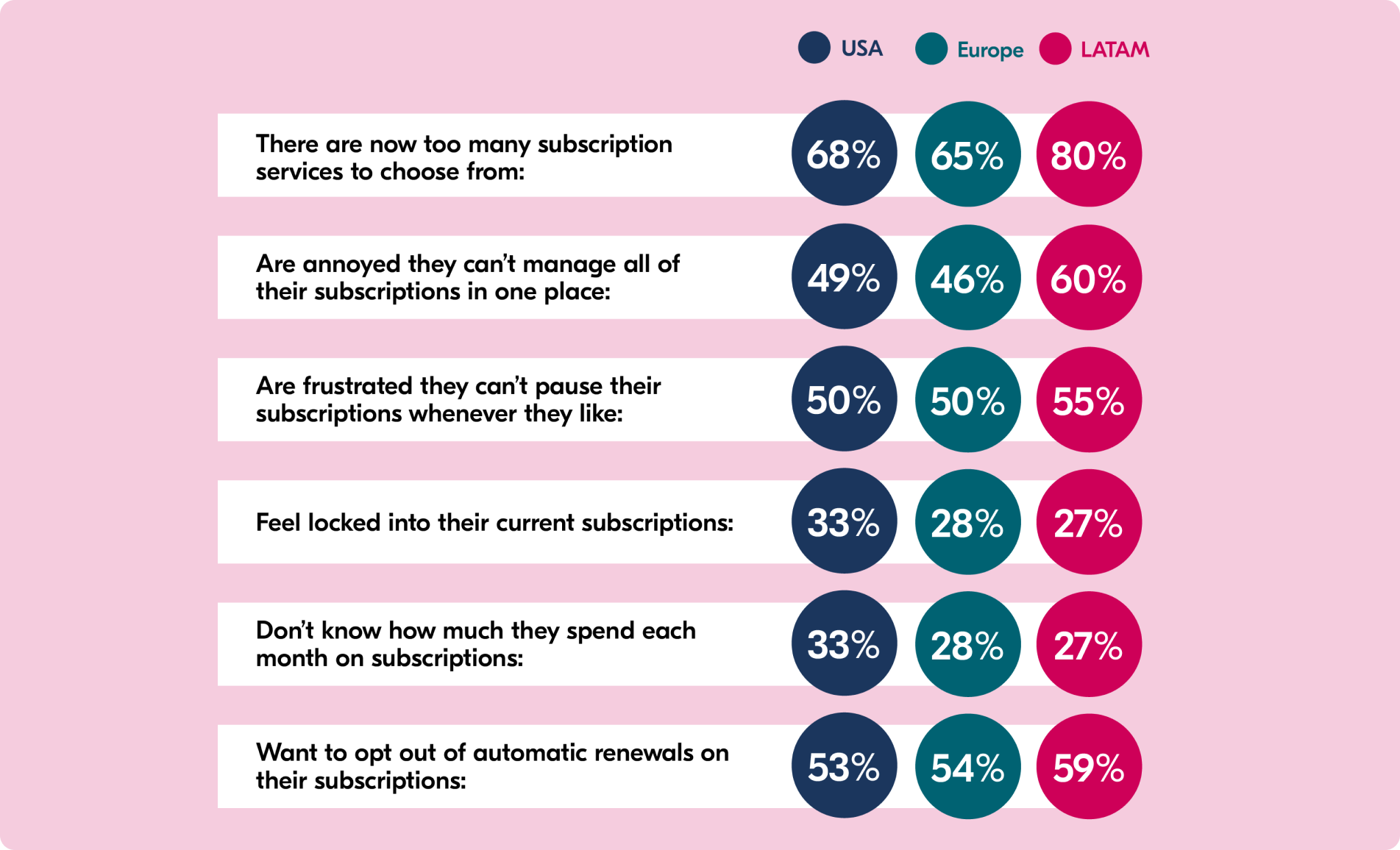
Subscribers are facing frustration due to struggles shared across the board: the overwhelming number of services, poor management options, inflexibility and high costs.
While these issues are universal, our data shows these frustrations are strongest in LATAM, where more subscribers than any other region are “annoyed” they can’t manage all of their subscriptions in one place, with a majority (80%) believing there are simply too many subscriptions to choose from.
For content providers looking to thrive internationally, managing these subscriber frustrations has to be priority one.
Subscribers’ perceptions of their subscription services
When it comes to managing current subscription services, subscribers have experienced difficulty…
USA | Europe | LATAM | |
|---|---|---|---|
Managing and updating personal details | 36% | 18% | 41% |
Accessing accounts across multiple devices | 35% | 20% | 33% |
Paying their bill | 32% | 20% | 26% |
Canceling their subscriptions | 29% | 14% | 18% |
Renewing their contracts or subscriptions | 27% | 18% | 28% |
Switching between accounts | 25% | 14% | 19% |
Remembering where they signed up to an offer | 21% | 10% | 11% |
Setting up new subscription apps | 21% | 14% | 21% |
Setting up additional plans or group accounts (e.g. family plans) | 18% | 10% | 15% |
2. Subscribers spending more than ever
In every market, subscription services have been expanding their offerings and increasing fees in an effort to boost revenue. This approach to monetization has meant not only broadening the range of available content and services but also bringing in new pricing models – including straightforward price hikes.
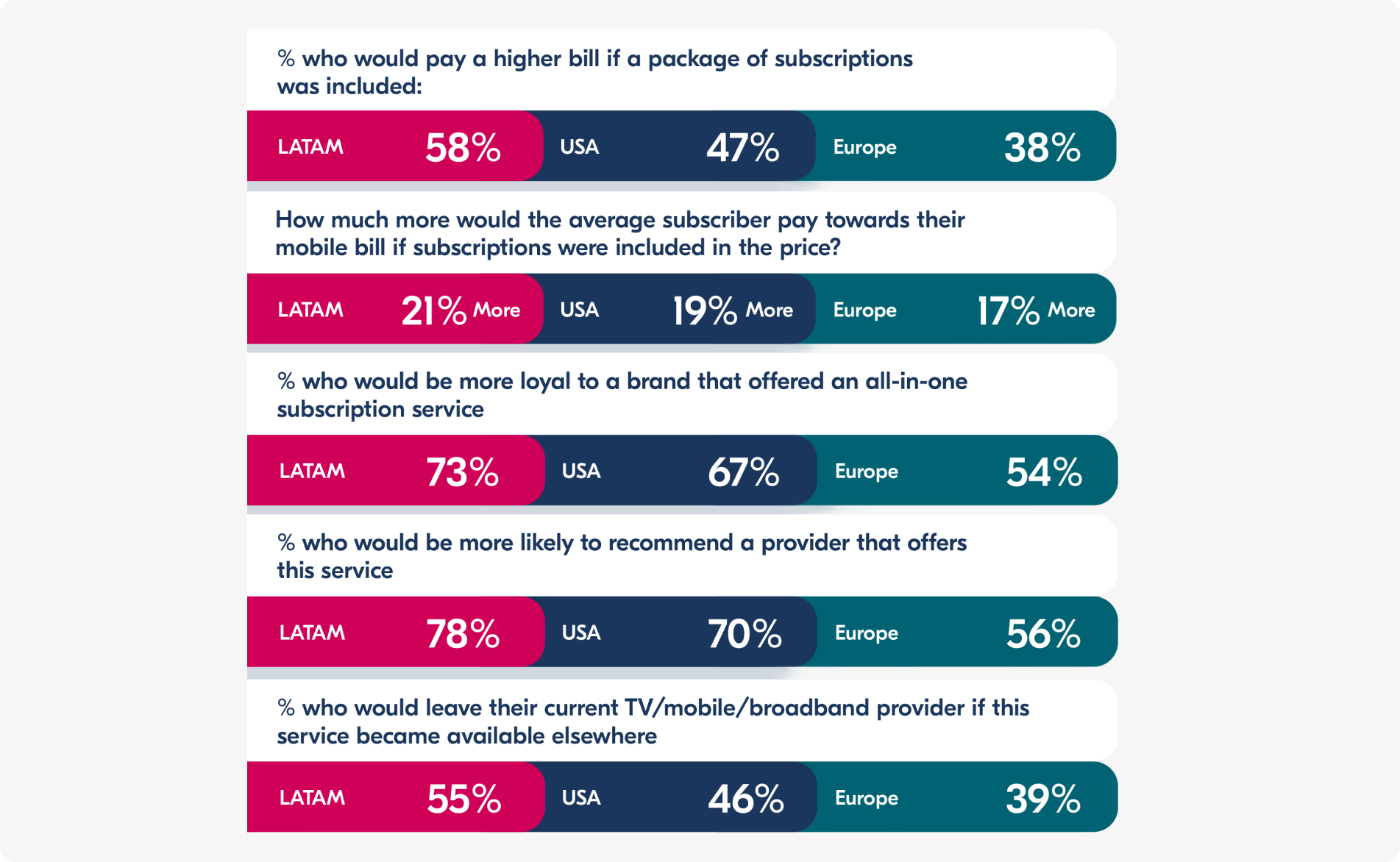
While this has driven growth and innovation in the industry, it has also piled financial pressure on subscribers, who are increasingly hitting a price ceiling. Well over half of subscribers we surveyed simply cannot afford all of the subscriptions they want.
The LATAM market was the first to see significant price increases, starting in early 2023 with providers including Netflix, Disney+ and Amazon Prime. These early increases soon spread to other regions, including Europe and the USA.
Providers must recognize that a model of steady price increases is unsustainable in the long term. To retain subscribers, they must offer greater value, flexibility, and transparency. This might include tiered pricing models, bundled offers, and improved customer experiences that justify the cost and build loyalty.
Spending on subscriptions:
$924
The average American pays per year
$762
The average European pays per year
$444
The average Latin American pays per year
% of subscribers who have canceled a subscription due to recent price increases:
USA
Europe
LATAM
% of subscribers who can’t afford all the subscriptions they would like:
USA
Europe
LATAM
3. Password sharing crackdowns a winner for streamers
As part of the broader global effort to monetize subscribers, subscription services have been cracking down on password sharing.
Streaming giants are spearheading the campaign. Netflix was the first to toughen up on password sharing in 2023 and has rolled out policies that restrict account sharing beyond household members, using tools like periodic verification checks and multi-factor authentication to enforce them. The company has made it clear that password sharing hampers their ability to invest in fresh content.
Disney+ followed suit earlier this year, with CEO Bob Iger arguing that there is “an opportunity here to help us grow our business”. Inspired by Netflix’s example, WB Discovery has also announced that their platform, HBO Max, will be cracking down on password sharing in late 2024.
The crackdown on password sharing has proven effective across all regions, particularly in the Americas. In the USA, for example, Netflix reported an immediate rise in new subscriber sign-ups following the implementation of their anti-password sharing measures. This was also reflected in the quarterly results – with Q1 2024 reporting 24% more sign-ups than the previous year. This uptick suggests that many users who were previously sharing accounts are now opting to pay for their own subscriptions – as reflected in our own data.
% of subscribers who are now paying for a service they used to access for free:
USA
Europe
LATAM
Pirate streaming
Piracy remains a concern. Could frustration, price hikes, and password crackdowns make things worse?
1 in 5 European subscribers (19%) are using pirate streaming services as the only way to access content in one place.
A similar proportion of LATAM subscribers (21%) are using pirate streaming services as the only way to access content in one place.
However over a quarter of USA subscribers (27%) are using pirate streaming services as the only way to access content in one place, making them the worst offenders.
4. Tiered subscriptions unlock new growth
Despite their relatively recent introduction onto the market, it looks like tiered subscriptions are here to stay. Lower-cost or free tiers supported by ads are making premium content accessible to a broader audience. This model particularly appeals to budget-conscious consumers who are willing to watch ads in exchange for reduced subscription fees.
Ad tiering is offering subscribers greater choice and flexibility, but subscription services need to find the right balance between affordability and user experience. Ads that are too frequent, or poorly integrated into the streaming experience, can lead to dissatisfaction and higher churn rates.
Our data shows that many subscribers have already canceled their subscriptions due to the introduction of ads, and a strongly held belief that paid subscriptions “should never display ads”.
Key statistics | USA | Europe | LATAM |
|---|---|---|---|
% of subscribers who have downgraded a subscription since a cheaper ad tier | 40% | 31% | 34% |
% of subscribers who have upgraded their subscriptions since an ad-supported version was launched | 36% | 26% | 34% |
% who have canceled a subscription due to the introduction of ads | 31% | 28% | 44% |
% who believe paid subscriptions should “never” display ads | 78% | 76% | 86% |
Mobile-tiers take root
LATAM is leading the way with the introduction of ‘mobile tiers’. Recognizing the mobile-first nature of the market, where smartphones are the primary means of internet access, services like Paramount+ have launched mobile-specific subscription plans.
These tiers are more affordable and tailored to the viewing habits of mobile users, offering content optimized for smaller screens and varying data consumption needs. This approach not only expands the subscriber base but also increases engagement by meeting users where they are most active.
5. Subscription flexibility meets brand loyalty globally
There are subscribers everywhere who frequently pause and restart subscriptions as they see fit – but nowhere more so than LATAM, where subscribers restlessly move from sub to sub.
In contrast, American subscribers show remarkable loyalty to their favorite subscriptions. Three-quarters of Americans report having at least one subscription they will never cancel – demonstrating strong brand loyalty to an elite club of ‘Forever Subscriptions’. This represents a huge prize to subscriptions that can break into that club.
European subscribers occupy a middle ground. They are the least likely to pause and restart their subscriptions, leaning towards consistency and stability. However, they are also the least likely to hold onto ‘Forever Subscriptions,’ showing less long-term commitment than their American counterparts. This behavior suggests that while Europeans value continuous service, they are also open to switching providers if a better option becomes available.
% of subscribers who frequently pause and restart different subscription services:
USA
Europe
LATAM
% of subscribers that say there are some subscription services they will always keep, and never pause/cancel:
USA
Europe
LATAM
6. Americans lose track of subscription spending
In the subscription economy, Americans are the most likely to lose track of their spending.
With the average American subscriber juggling multiple subscriptions and paying almost a thousand dollars a year, it’s easy for expenses to slip through the cracks. And while the USA holds the top spot for out-ofcontrol spending, it remains a universal issue – both south of the border in LATAM and across the Atlantic in Europe.
This often results in subscribers paying for services they aren’t even using – creating a class of ‘vampire subscriptions’ that silently drain their finances while sitting forgotten and neglected. This isn’t the fault of the subscription service, or even the consumer. Several factors contribute to this widespread problem.
The sheer number of subscriptions makes it understandably difficult for consumers to track each one. Automatic renewals and the lack of centralized management tools further complicate the process. And naturally, subscription management often falls to the bottom of the priority list for busy subscribers.
For companies aiming to enter or grow in these markets, understanding this issue is crucial. Introducing management tools that track spending, send renewal alerts, and highlight unused subscriptions can supercharge the user experience. Happier customers will be more loyal and less likely to cancel their subscriptions.
% of subscribers who don’t know how much they spend each month on subscriptions:
USA
Europe
LATAM
% who find it too hard to keep track of where and how they signed up to subscriptions:
USA
Europe
LATAM
% who currently pay to subscribe to an app or streaming service they’re not using:
USA
Europe
LATAM
7. Indirect subscriptions strong in Europe
Many subscribers are on the hunt for the best possible deals, looking for new cost effective ways to sign up to their favorite subscriptions. As a result, indirect subscriptions have become a major market in 2024, with combined subscriptions, unique bundles, and third-party selling all proving essential drivers of growth.
Close to a third of Europeans now subscribe exclusively to services indirectly — meaning not directly through the subscription itself (e.g. Netflix via the Netflix website or app).
Many of these indirect subscriptions are delivered via telco companies. In the UK, EE offers packages that include subscriptions to services like Netflix, Amazon Prime Video, and NOW TV. France’s Orange offers a bundle called “Love & Go” which includes high-speed internet, TV, and a Netflix subscription.
Other regions are following suit, with 1 in 5 subscribers in both LATAM and the USA now going indirect for their subscriptions.
1 in 5 USA subscribers now go exclusively indirect for their subscriptions
Almost a third of European subscribers now go exclusively indirect for their subscriptions
1 in 5 LATAM subscribers now go exclusively indirect for their subscriptions
How have consumers subscribed to their existing subscription services?
USA | Europe | LATAM | |
|---|---|---|---|
Directly via a content provider (e.g. via the Netflix website or app) | 80% | 70% | 79% |
Through another service they already subscribe to (e.g. They bought Paramount+ via the Prime Video app) | 34% | 20% | 14% |
Bundled free with other services (e.g. part of a deal with a pay TV or mobile operator) | 29% | 23% | 21% |
Sold to them by a third-party service (e.g. They bought Netflix from my mobile phone provider, bank, supermarket, etc.) | 15% | 12% | 16% |
Via a coupon (e.g. They were offered a discount coupon which they then used to subscribe on the e.g. Netflix website) | 12% | 6% | 4% |
Via a pre-paid gift card | 4% | 3% | 3% |
8. Subscribers demand Super Bundling
Subscribers around the globe are increasingly going indirect for their subscriptions, signing up via bundles and deals from third-party services.
As they look for greater flexibility and lower costs, 2024 looks set to be remembered as the year of Super Bundling – with huge opportunities for companies willing to meet subscriber demands.
In LATAM in particular, the market is crying out for a Super Bundling platform, with the majority (79%) of subscribers demanding a single app to manage all of their subscriptions. This figure is closely followed by the USA, where three-quarters echo the demand, despite the presence of a content hub like Verizon +play already on the market there, showing still untapped demand.
They want more. And for good reason: many point to taking pressure off their household expenses. The majority of subscribers across all surveyed regions feel they would better manage their expenses if a Super Bundling content hub became available.
% of subscribers demanding one app to manage all their subscriptions and accounts:
USA
Europe
LATAM
% who feel they would better manage their household expenses if this service was available:
USA
Europe
LATAM
9. Content hubs take centre stage
In the USA and Australia, full-service ‘content hubs’ like Verizon +play and Optus SubHub have made waves in the subscription market with their consumer-first convenience that gives subscribers both flexibility and control.
Verizon’s +play customers can manage their Xbox Game Pass, Max, NFL, and Snapchat+ accounts on one platform, while Optus customers can combine their Netflix, Calm, Kindle, and Sweat subscriptions under one SubHub roof.
Subscribers are calling out for these types of all-in-one platforms to break into the European and LATAM markets.
% who would spend more time using their subscription services if an all-in-one subscription platform was available:
USA
Europe
LATAM
% who would sign up to more subscription services if an all-in-one subscription platform was available:
USA
Europe
LATAM
Features subscribers want from all-in-one subscription platforms
USA | Europe | LATAM | |
|---|---|---|---|
Ability to pay multiple subscriptions via one monthly bill | 69% | 50% | 69% |
Discounts on the subscription services | 54% | 35% | 41% |
Ability to temporarily pause subscriptions (‘payment holidays’) | 50% | 45% | 46% |
Ability to calculate the best deals and prices across all platforms | 45% | 32% | 41% |
Ability to change subscription duration (weekly vs monthly vs annually) | 41% | 34% | 39% |
Ability to centrally update payment details | 40% | 31% | 40% |
Access to all content within a single platform | 38% | 23% | 29% |
Visibility of costs saved through deals and promotions on my monthly bill | 34% | 20% | 25% |
Ability to switch between premium and ad-funded tier | 34% | 22% | 22% |
10. Telcos scale up the subscription economy
As well as demanding content hubs, subscribers have also made it clear that they want telcos to offer these services and they’re willing to pay for it.
While European and LATAM telcos are already creating subscription based deals, few currently combine subscriptions outside SVOD.
With mobile providing the key platform for content consumers in LATAM, it’s no surprise that the majority (55%) of subscribers there want mobile providers to lead the charge on creating centralized content hubs – more than the USA (50%) and Europe (46%).
While telcos are the most strongly preferred choice as content hub providers, payments companies and banks are following in second – indicating where this market could develop next as these companies respond to consumer demand.
Super Bundling will be the key technology that allows this expansion to happen.
Who do subscribers want to provide content hubs?
USA | Europe | LATAM | |
|---|---|---|---|
Mobile operators | 50% | 46% | 55% |
TV, satellite, or cable provider | 29% | 17% | 16% |
Payment or wallet company | 26% | 16% | 24% |
Broadband provider | 26% | 36% | 30% |
Banks or credit union | 18% | 15% | 24% |
Retailer | 18% | 10% | 9% |
A social media platform/app | 15% | 7% | 12% |
For a deeper dive into each region, learn more at:
- Subscription Wars: Super Bundling Awakens USA
- Subscription Wars: Super Bundling Awakens Europe
- Subscription Wars: Super Bundling Awakens Latin America
Super Bundling: Where do I start?
Content providers
Super Bundling gives content providers instant access to a ready-made distribution, marketing and billing network offered by telcos and other channels around the world. Bringing together telcos and content providers in one place, the Digital Vending Machine® from Bango is a SaaS product that enables the Super Bundling of content subscriptions.
Several global telcos have already created their own vibrant content hubs – bringing together dozens of providers including Netflix, ESPN, Amazon Prime, Duolingo, YouTube, Peloton, Audible and more in one seamlessly integrated solution.
The Digital Vending Machine® from Bango isn’t just for established players. The low barrier to entry means it’s ideal for content and service providers looking to make a name for themselves. Plus, it opens doors to some of the biggest reseller networks around including telcos, banks and retailers. Support for a range of commercial models means that the Digital Vending Machine® from Bango ensures you get to market at speed and with minimal integration pain.
Telcos
The Digital Vending Machine® from Bango is loaded with pre-built integrations for hundreds of subscription products, apps, and streaming services. We provide all the core requirements via standardized technology enabling telcos to deliver Super Bundling in months, rather than years.
The Digital Vending Machine® from Bango is available as a SaaS product, which means telcos can quickly and easily scale, gaining access to a constantly evolving and growing ecosystem of global subscription and content providers.
This happens through a single one-to-many integration, avoiding time- consuming one-to-one arrangements. Enabling this super-fast time to market means that telcos can focus on the things that matter most to them: customer acquisition, retention and engagement. Developing subscription hubs with Verizon and Optus, we’ve helped create deals spanning Netflix, ESPN, Amazon Prime, Duolingo, YouTube, Peloton, Audible and more.
The Digital Vending Machine® from Bango brings together resellers and content providers to enable Super Bundling of subscriptions at speed and scale.