
Gravity Shift – subscribers, bundles, and the acquisition black hole
Gravity is shifting
For over a decade, subscription businesses have grown through the power of direct-to- consumer marketing. It’s been the engine behind some of the world’s most successful brands. In 2025, the subscription economy continues to power ahead, but the growth equation is shifting.
Nearly half of subscription leaders say returns from direct acquisition are declining, while over half report that oncereliable strategies such as paid search, display advertising and social media ads are becoming harder to sustain.
At the same time, subscriber expectations are changing. Consumers feel overwhelmed by choice, frustrated by friction, and are seeking value in new places. Increasingly, they want subscriptions bundled into services they already use, trust, and pay for.
This isn’t the end of direct. It’s a gravitational shift – a fundamental change in the forces driving growth. It’s a chance to unlock new audiences, expand brand reach, and drive acquisition without spiraling costs.
For subscription providers looking to navigate this shift, this report offers a chance to learn from those already leading the way. Based on insights from 201 senior decision-makers at subscription brands spanning AI, education, finance, food delivery, SVOD, retail, and more, it reveals how the industry is evolving: from direct to indirect, and from a subscription economy to a bundle economy.
Methodology
This report includes data from 201 crossindustry subscription leaders across the USA and UK, all with responsibility for customer acquisition strategies and budgets. The streaming and subscription brands surveyed spanned entertainment, food, wellbeing & lifestyle, retail, finance, learning, home & living and productivity apps. Job titles included CEOs, CMOs, CROs, VPs, Directors, and Managing Partners.
Commissioned by Bango and conducted by independent research agency Vitreous World, the Gravity Shift research was carried out in May 2025.
In this report, you’ll discover
- How direct acquisition became a spending black hole
- Where leading subscription brands are shifting their 2025 budgets
- Why breaking orbit from “direct-only” is the next growth frontier
- What bundling and Super Bundling mean for your bottom line
- Where subscriber acquisition goes next, beyond bundles
- How indirect acquisition delivers lift-off for your growth
- What friction points are stalling subscriber acquisition
- How your subscription product can boom in the bundle economy
1. Direct acquisition: A spending black hole?
Direct acquisition isn’t going anywhere, but the costs are skyrocketing. Netflix spent a staggering $2.9 billion on marketing in 2024, including $1.7 billion on pure advertising. Spotify is rumoured to spend around $1.5 billion a year. For many subscription leaders, this spiralling spend just isn’t sustainable.
Today, nearly half of subscription leaders (48%) say their investment in direct acquisition is yielding diminishing returns.
The warning signs are everywhere: 88% expect customer acquisition costs through direct channels to rise this year, and 31% believe those costs will increase ‘significantly’. Nearly half (46%) of our subscription leaders went as far as to agree that direct acquisition has become a ‘black hole’ for subscription spending.
So, what’s driving the downturn? Rising ad costs, privacy restrictions, and crowded markets have all played a role. Meanwhile, subscriber fatigue and declining engagement mean even the best-placed ads struggle to convert.
Believe direct acquisition is no longer a sustainable strategy
Are cutting back on at least one direct acquisition channel this year
Expect acquisition costs through direct channels to rise this year
Subscription leaders shared their biggest challenges of direct acquisition
2. Course correction: Shifting spend and strategy
Facing rising costs and the risk of falling ROI, subscription providers are taking action. Eight in ten subscription leaders (80%) say their brands are actively cutting back on at least one direct acquisition channel in 2025.
The most heavily impacted? Paid search (33%), display advertising (30%), and paid social (29%).
These direct channels aren’t being jettisoned entirely. But subscription providers are on the hunt for new, more reliable (and more cost effective) ways to drive growth and secure their futures.
Enter indirect acquisition.
Which direct channels are subscription brands cutting back on this year?
3. Breaking orbit: Leaving direct-only behind
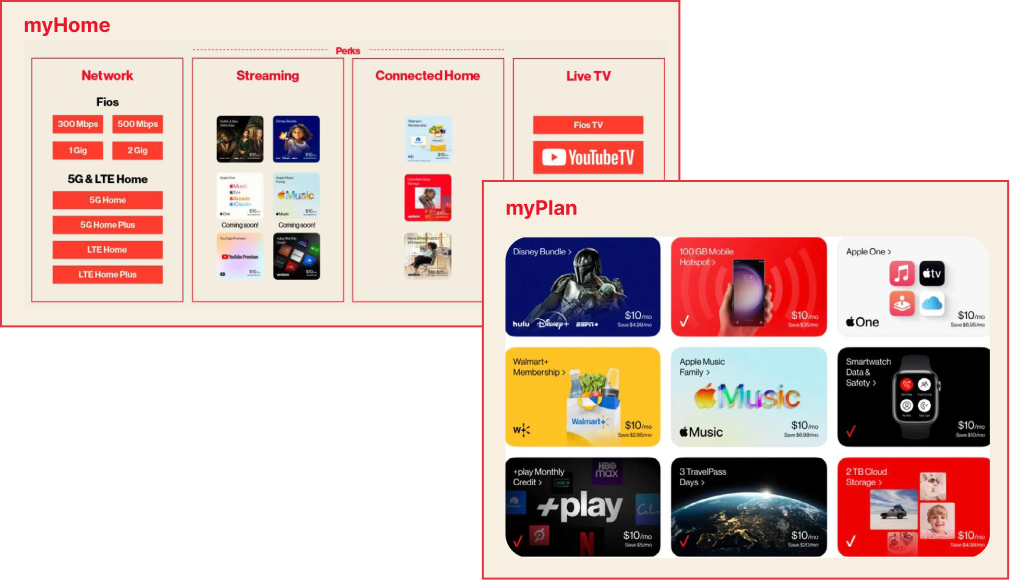
The smart subscription brands are working beyond direct channels, to reach subscribers in more natural, value-driven ways. Whether it’s being bundled into a customer’s telco plan, sold via a loyalty scheme, or offered through a Super Bundle like Verizon myPlan & myHome, indirect channels are opening up a new world of acquisition opportunities.
Over three-quarters (77%) of subscription leaders say they’re prioritizing indirect acquisition strategies in 2025.
And 82% are planning to increase their spend on these channels, with a third expecting to boost spending ‘significantly’.
Across the industry, acquisition strategies are evolving. What we are increasingly calling the ‘bundle economy’ is seeing subscription providers move from one-to-one targeting to one-to-many partnerships. From isolated spending to ecosystem thinking. From standalone efforts to more collaborative, crossindustry partnerships.
Of subscription leaders plan to increase investment in indirect acquisition this year
Agree successful subscriber acquisition now requires both direct and indirect channels
Say they are prioritizing indirect acquisition strategies this year
4. Gravity center: Bundling and Super Bundling
While there are various forms of indirect partnerships, bundling and Super Bundling are rapidly becoming a cornerstone of the new acquisition approach. Nine out of ten subscription leaders (90%) are either already using bundles for acquisition or plan to adopt them in 2025. More than a quarter (27%) are also participating in, or plan to participate in, all-in-one Super Bundling platforms.
The new bundle economy
Telcos and mobile providers
42% are bundling, or planning to bundle, their subscriptions via telcos and mobile providers in 2025
Retailers
44% are bundling, or planning to bundle, their subscriptions via retailers in 2025
Banks & financial institutions
44% are bundling, or planning to bundle, their subscriptions via banks and financial institutions in 2025
Bundling is evolving beyond simple offers and deals. It’s becoming a sophisticated indirect ecosystem involving telcos, retailers and financial institutions — all offering access to a wide range of subscription services. This is the bundle economy in action.
Most importantly, this is also how consumers want to subscribe. Our recent subscriber research shows that 44% of US subscribers already receive at least one subscription through a bundled deal, showing just how embedded (and expected) this approach has become.
Of subscription leaders are using or planning to use bundling for acquisition in 2025
“Bundling offers convenience and cost saving. But it can also foster loyalty and retention of customers by providing them with a more integrated and supportive experience.”
Department Head, food delivery subscription

Case Study: The bundle economy in action – Verizon myPlan & myHome
Verizon myPlan & myHome allow subscribers to discover, manage, and pay for dozens of subscriptions including Netflix, Disney+, Apple One, YouTube Premium and Walmart+ in one place via their Verizon account.
This Super Bundling model is powered by the Digital Vending Machine® (DVMTM) from Bango, which links subscription brands into a shared ecosystem. For leaders looking to create bundles and offers without a heavy technical lift, the DVM offers plug-and-play access to partners and promotions. This indirect approach also lets subscription brands tap into Verizon’s huge audience of existing bill-payers, ready to activate new subscriptions at the push of a button.
It’s a win-win: brands reduce acquisition costs and subscribers gain flexibility and control.
And this is just the beginning. Hans Vestberg, CEO of Verizon Wireless announced the company’s ambition to grow from 7 million to 15 million managed subscriptions by end of 2025 — including Netflix, Disney+, Apple, Max and more — all in one seamless, subscriber-first platform.
5. Beyond Bundles: An expanding universe
While bundling is a clear favorite for subscriber growth, it’s just one piece of a much larger universe.
Subscription leaders are tapping into a wide range of indirect strategies to improve reach, retention, and return on investment.
From loyalty schemes, to device integrations, and workplace perks, brands are finding creative ways to meet subscribers where they already are.
This expansion reflects a growing belief that acquisition doesn’t have to be direct to be effective. Instead of spending more, brands are spending smarter, and embedding subscriptions into people’s everyday routines and trusted environments.
Where are subscription leaders investing beyond traditional ‘bundles’?
Partnerships with device makers and platforms (e.g. TV manufacturers)
Points-based loyalty partnerships
Employee benefit scheme partnerships
Alongside these partnerships, there’s also a growing interest in the potential for bundles to be offered by social media platforms. Nearly half (47%) of respondents are exploring this option. This echoes findings from our Subscriptions Assemble report, which revealed that one in five Gen Z consumers (the most subscribed generation) want their subscriptions bundled with social platforms in future.
6. Lift off: The power of indirect
For subscription brands already using indirect acquisition channels, the benefits go far beyond a reduced spend on ads.
According to subscription leaders, partnering through bundles, deals, and other indirect routes has helped boost everything from brand credibility to customer retention, acquisition efficiency, and access to valuable subscriber data.
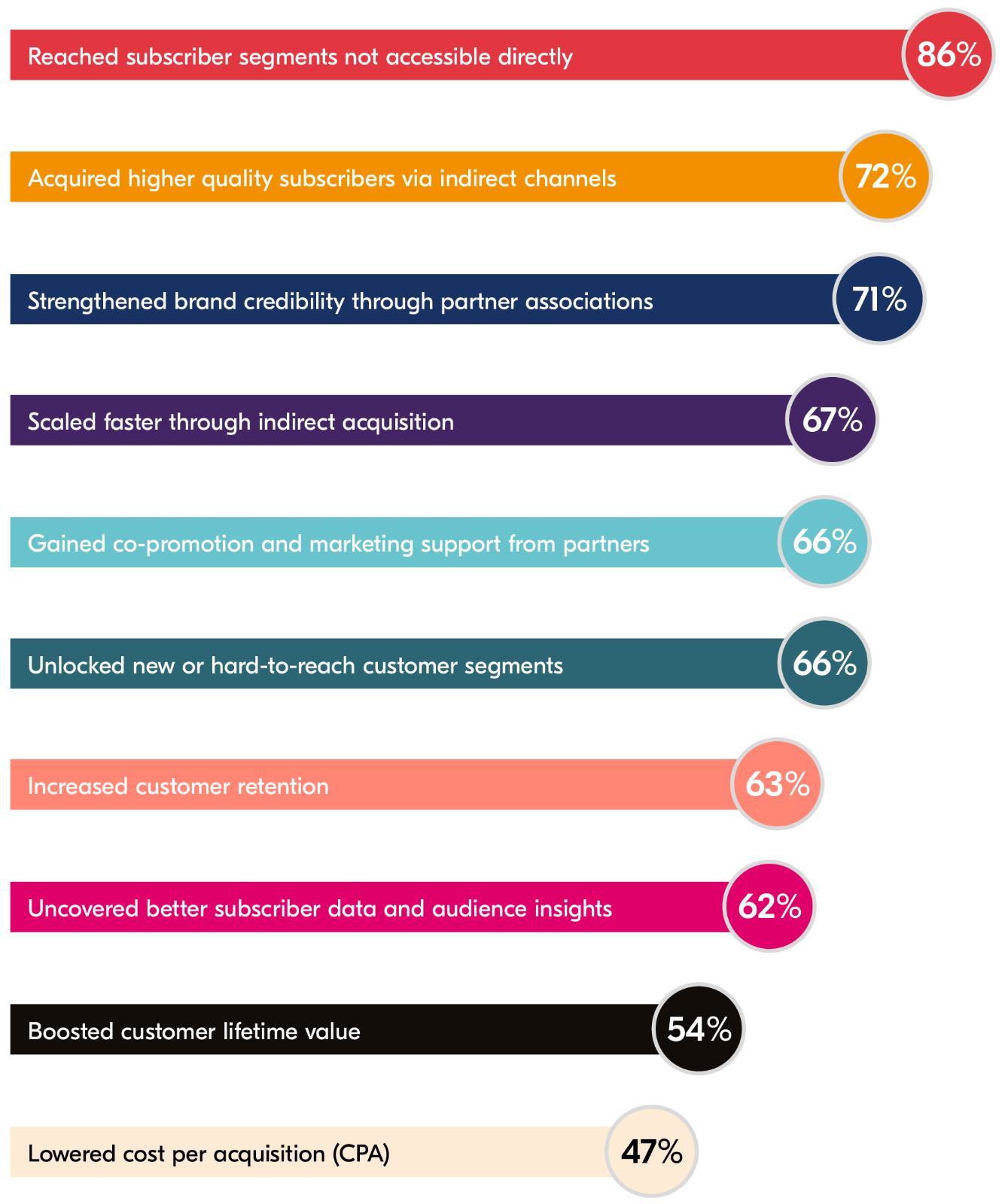
One of the biggest advantages is reach, with 86% saying indirect channels let them access subscriber segments they couldn’t reach directly. Just as importantly, 72% report that these subscribers have a higher lifetime value (LTV) than those acquired through traditional direct channels.
Co-promotion is another key benefit. By partnering with other brands, 66% have gained additional marketing exposure, tapping into wider audiences without shouldering the full burden of promotional spend. These collaborations enhance credibility while amplifying marketing impact.
Finally, 62% of brands say indirect acquisition has helped them unlock richer subscriber data and deeper audience insights, empowering smarter and more targeted marketing strategies.
Top 10 benefits reported after investing in indirect acquisation graph here
What our clients say..
“Indirect gets our product out to a larger number of subscribers, many of whom may not consider or find us without the bundling option.”
Director, SVOD subscription
“Bundling increases customer value, customer retention, revenue growth, cross selling, and provides opportunities for competitive differentiation.”
CEO, software subscription
“Bundling has expanded our customer base.”
Director, SVOD subscription
“Bundling allows us to reach new customer segments we may not access through direct channels alone, especially when partnering with trusted brands or platforms.”
CEO, software subscription
“Bundling offers a strategic way to increase customer value by combining complementary services… and it can drive higher revenue per user by encouraging uptake of additional services.”
Director, health and fitness subscription
“Bundling reduced our CPA by 28% – because cross-selling is cheaper than directly acquiring new customers.”
SVP, social media subscription
7. Friction point: Barriers to the bundle economy
Given the clear benefits of indirect channels, along with the rising costs and diminishing returns of direct acquisition, why haven’t more subscription providers made the shift? Despite the strong return on investment, 92% of subscription leaders report at least one barrier preventing further adoption of indirect strategies.
Many of these challenges are structural, including the complexity of contracts and deals with bundling partners, integration issues, and difficulties with performance measurement. Others are more operational, such as limited internal resources or concerns about long-term return on investment.
Leaders identified a series of clear blockers to fully embracing the bundle economy and unlocking new growth:
Complex and timeconsuming contracts
Difficulty identifying and securing the right partners
Hard-to-measure performance and ROI
Complex setup of offers and bundles
Integration issues with partners
These are solvable problems, but only if platforms, partners, and processes evolve to make indirect easier, faster, and more measurable.
8. Digital Vending Machine®: Making the bundle economy possible
The subscription economy is ready to shift. With direct acquisition increasingly seen as a spending ‘black hole’, leaders know it’s no longer a reliable engine for growth. Instead, they’re eager to embrace new, more sustainable ways to scale and retain their subscriber base.
But to move fast, they need the right infrastructure.
That’s why we built the Digital Vending Machine® (DVMTM) from Bango — to remove complexity from the world of bundling.
The DVM connects hundreds of subscription services into one easyto- access ecosystem, allowing any subscription to be bundled, promoted, and distributed through telcos, banks, retailers, social media platforms, and more.
For subscription marketers, it means faster, smarter acquisition at a lower cost. For partnerships teams, it means instant access to a global network of bundling opportunities without months of integration. For subscription leaders, it means unlocking the scale and efficiency needed to achieve sustainable growth.
From Super Bundling through Verizon myPlan & myHome, to telco add-ons and retail loyalty programs, the DVM powers the partnerships, offers and deals that drive the bundle economy.
The DVM already helps hundreds of subscription providers including Netflix, Amazon Prime, Xbox, Disney+, YouTube, Uber, and more, connect and grow without the hassle of complex contracts and lengthy integration periods