
Streaming squeeze: Why SVOD wins when subscribers cut back
Introduction
Household budgets are under strain.
From groceries to gas, consumers are cutting back. And yet, one expense continues to hold firm: streaming.
Even as inflation bites, millions are choosing to protect their video subscriptions, finding ways to save elsewhere instead.
Calling on research from 2,000 subscription video on demand (SVOD) subscribers, this report explores why streaming remains essential spending in 2025: how ad tiers, bundling and smarter billing are helping viewers stay connected without overspending.
It also reveals a new kind of subscriber: flexible, value-driven and selective rather than loyal to all.
As the market shifts, and belts tighten, the winners will be those services that simplify access, adapt to changing budgets and make entertainment feel indispensable, even in hard times.
Data methodology
This report includes data from 2,000 US SVOD subscribers, exploring their attitudes and behaviors in the face of cost of living challenges.
Commissioned by Bango and conducted by independent research agency 3Gem, the Streaming Squeeze: Why SVOD Wins When Subscribers Cut Back research was conducted in September 2025.
In this report, you’ll discover
- Why streaming stays essential even as consumers cut back
- How ad tiers balance affordability and exclusivity
- Which “Forever Subscriptions” dominate and how others can keep up
- Bundling and the saver mindset
- The future of subscription growth
1. The streaming squeeze
Higher cost of living means consumers are feeling the squeeze. But despite tighter budgets, one thing remains true — they still love their streaming services.
In fact, one in three (34%) have gone as far as to cut back on other household expenses, just to keep their SVOD subscriptions. 30% are also still choosing to pay for four or more SVOD services, in spite of tough economic times — suggesting that SVOD has moved from a luxury to essential status.
Even among the lowest earning households, the majority of SVOD subscribers still pay for at least two different streaming services.
But while consumers are clearly committed to streaming, the pressure to cut back is building. Nearly two-thirds of subscribers (63%) say they can’t afford all the services they want, and 55% now describe their total SVOD commitment as “too expensive.”
The result is a new, more Savvy Subscriber. One who adapts, rotates and seeks value — instead of parting with their streaming services altogether.
As this shift from “cancel or keep” to “manage and adapt” takes hold, consumers are looking for smarter, more budget-friendly ways to subscribe. And the services that meet this need, whether it’s through unified billing, flexible bundles, or intelligent distribution, will be best placed to capture this growing audience.
of SVOD subscribers have cut other household expenses to keep streaming
of SVOD subscribers still pay for 4 or more SVOD services
of SVOD subscribers can’t afford all the streaming video subscriptions they want
2. Ad-tiers and the price of choice
Affordability has become a major sticking point for consumers and SVOD services have turned to ad-tiering as a way to lighten the load. And yet, two years after Netflix’s ad supported plan hit the market, subscribers remain split.
While 69% say paid subscriptions should never show ads, 60% would accept more ads in exchange for a bigger discount. This shows a clash between what people want and what they’re willing to pay for — something ad-tiering can balance.
Fundamentally, ad-tiering provides consumers with options — and with more options comes more opportunity for services to capture different audiences. When cheaper ad-supported plans launch, 42% of subscribers downgrade their plans. But, 39% paid to upgrade to an adfree plan instead. This behavior is particularly common among Gen Z, with 47% having signed up to an SVOD subscription thanks to an ad-tier.
Ads, however, are certainly not for everyone. Drilling into the data, it’s the highest earners who are the most ad-averse. Three quarters (75%) of those earning over $100k believe paid streaming should remain ad-free. Ad tiers make that divide visible, offering affordability for some while reinforcing premium status for others.
By letting consumers adjust rather than cancel, ad tiers can help providers protect both revenue and engagement, giving audiences choice and control while ensuring a steady income for subscription brands.
of Gen Z say they started a subscription because of an ad-tier offer
(compared with just 25% of Boomers)
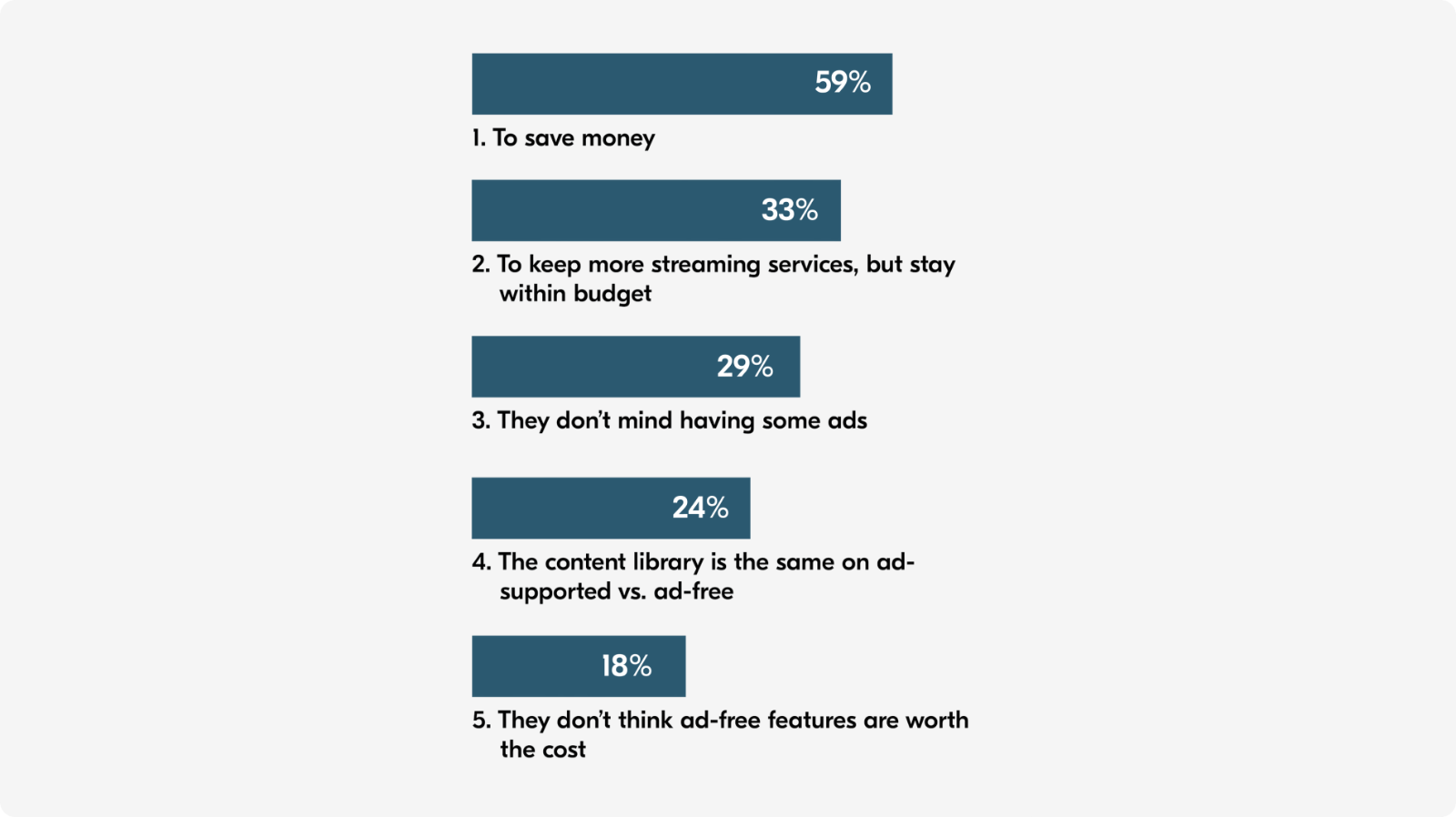
Top five reasons SVOD subscribers switch to ad-supported tiers
3. The “Forever Subscription” effect
Even as households tighten spending and subscribers reassess their streaming mix, some services remain untouchable. They’re just too essential to let go of.
These are what we at Bango call “Forever Subscriptions”: the services that subscribers refuse to cancel, no matter what.
In 2025, Netflix dominates this list, with 60% of SVOD subscribers declaring it a “Forever Subscription”. This is almost twice as many as Prime Video at 31%, and Hulu at 24%, both falling significantly behind Netflix’s loyalty lead.
Looking at different age brackets, Netflix also secures cross-generational appeal, which highlights its universal pull. In contrast, Prime Video skews older, with 45% of Boomers considering it a Forever Subscription — more than any other generation. At the other end of the scale, Disney+ resonates with younger audiences (28% of Gen Z treat it as a Forever Subscription).
While not every subscription can be Netflix, for smaller or emerging services, the smart move may be to attach to these essential players rather than trying to compete. By bundling up with a Forever Subscription, SVOD services stand a far better chance of staying top of mind and top of wallet.
America’s top “Forever Subscription”
Which video streaming services would you keep ‘forever’, even if you needed to save money? [Choose up to 2]
Forever… everywhere
Netflix isn’t just America’s favorite “Forever Subscription”. Research from Bango in the UK shows a similar pattern, with 80% of UK subscribers naming Netflix as their forever choice.
4. Bundling and the saver mindset
After protecting their “Forever Subscriptions”, many Savvy Subscribers are finding smarter ways to afford the rest. Bundling has become the go-to strategy for keeping access while cutting costs, helping subscribers hold onto more of what they love without overspending.
Nearly two-thirds of SVOD subscribers (65%) reported that they would like bundled services over direct subscriptions to help manage household expenses, with one in five (22%) joining a bundle in the last six months. This rises to nearly a third (32%) for Gen Z.
For subscribers, these bundles provide meaningful savings, averaging $16.32 per month, with around half saving between $15 and $24.
For subscription brands, they offer a safety net, making their services part of larger, more valuable and more essential streaming ecosystems.
Streaming bundlers save $16.32 per month on average
of SVOD subscribers 22% have switched into a bundle in the last 6 months
Gen Z subscribers are 45% more likely to bundle their services
Bundles drive subscriber loyalty, stickiness and value
Subscribers who bundle their services typically:
- Pay for 15% more streaming services
- Are 10% less likely to cancel after price rises
- Are 35% less likely to see piracy as a viable alternative to streaming
5. The future of subscription growth
Even as wallets tighten, the consumer’s love affair with streaming shows no sign of slowing down. Viewers aren’t ready to give it up — in fact, they’re determined to keep their favorite services no matter what.
But with budgets under pressure, the next wave of SVOD growth won’t come from piling on more subscriptions, but from smarter, simpler ways to deliver them.
Together, these trends point to a market maturing toward integration: a bundle economy, where services succeed through collaboration rather than competition.
Given these trends, we believe that the next era of streaming will not be defined by how many SVODs consumers can subscribe to, but by how seamlessly they can stitch them together.
The services that make access effortless will transform a cluttered subscription landscape into one unified, cost-effective experience.
The new success formula for SVODs:
Flexibility
Ad tiers and pricing variety widen participation
Connection
Bundling aligns smaller services with household favorites
Convenience
Unified billing and distribution simplify commitment and control
Let’s get ready to bundle…
Connect once, distribute everywhere with the Digital Vending Machine® (DVM™) from Bango
The Bango DVM removes the heavy lift from partner contracting, entitlement, payments, and offer ops — linking you into live Super Bundling ecosystems (e.g., Optus SubHub, Verizon myPlan or Telenet’s enertainment marketplace) via one-to-many integration. That’s faster market entry, standardized offers and real-time performance data across third-party bundlers such as telcos, banks, wallets and retailers.
The bottom line
Productize choice. Distribute through bundles. Measure on LTV, not just sign-ups. Then let the Bango DVM do the heavy lifting so you can focus on content and customers. That’s how SVOD wins in a cost-conscious market.