
Subscription Wars: Super Bundling Awakens – East Asia
Survey of 5,000 East Asian subscribers explores shifting dynamics in the subscription economy
Introduction
The Subscription Wars research series from Bango continues its deep dive into the global battle for subscribers, focusing this time on East Asia
This dynamic region – encompassing Japan, South Korea, and Taiwan in this report – is characterized by rapid technological advancements, widespread 5G mobile coverage, and fast, ubiquitous broadband. This has made streaming content immensely popular and accessible across all demographics, setting the stage for fierce competition among subscription and content providers.
Bundling is far from new to this region. With smartphones the most popular form of internet access in the region, telcos play a central role in providing not only connectivity but also in offering and managing bundled digital content and services through mobile platforms. Companies like Softbank in Japan, SK Telecom in South Korea, and Line in Taiwan have long integrated services like e-commerce, banking, and even healthcare with entertainment subscriptions, providing a precedent for the delivery of multiple services through a single user experience.
Despite this existing service bundling culture, subscribers across East Asia express growing frustration with both the fragmentation and complexity of their subscriptions. Like other subscribers around the world, many feel overwhelmed by the sheer number of services they juggle and want more cohesive solutions.
To stay competitive and alleviate these frustrations, telcos and content providers in this region must go further. In this report, we’ll examine how they can benefit from a booming subscription market, discovering new audiences, driving retention, and unlocking new avenues for growth.
Methodology
This report includes data from 5,000 subscribers across Japan, South Korea, and Taiwan, exploring diverse aspects of their experience with subscription services.
Commissioned by Bango and conducted by independent research agency 3Gem, the Subscription Wars: Super Bundling Awakens – East Asia research was conducted in August 2024 and published in September 2024.

In this report, you’ll discover
- The state of subscriptions across East Asia: Japan, South Korea, and Taiwan
- The market trends driving change across the region
- The main sources of subscriber frustration
- The unique rise of indirect subscriptions
- The power of Super Bundling and how telcos are poised to take control
1. The state of subscriptions across East Asia
East Asia is a critical market for the global subscription economy, driven by a highly developed digital ecosystem and a strong consumer appetite for a wide range of services as subscriptions.
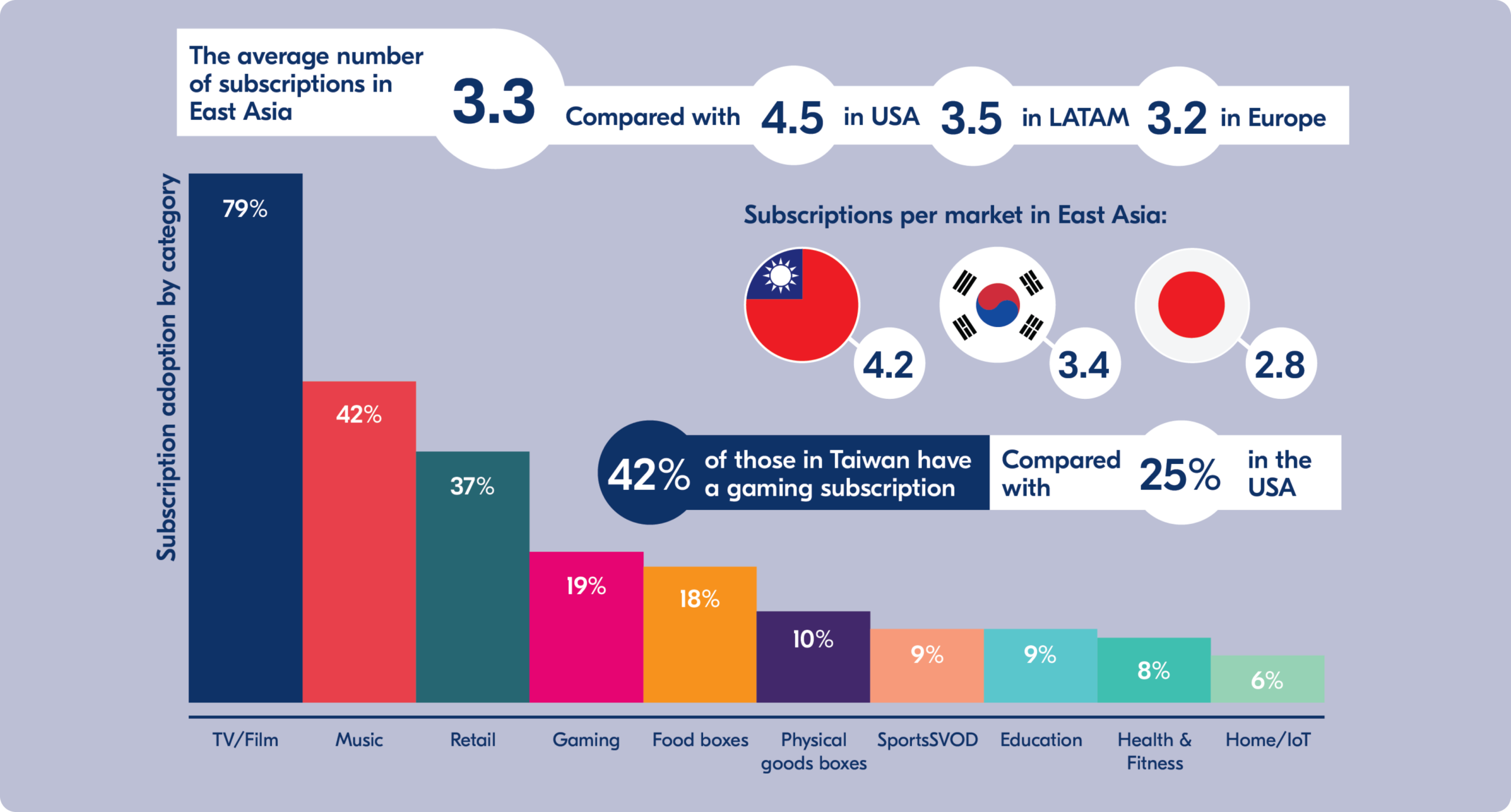
Subscribers in the region typically hold multiple subscriptions across various content types, with Subscription Video on Demand (SVOD) leading the way. This variety reflects the maturity of the subscription market, where well-established models exist not only in video streaming but also in music, gaming, and e-commerce.
However, with a maturing and competitive landscape, content providers face increasing pressure to stand out. Gaming subscriptions, in particular, have become a significant category, especially in the Taiwan market, where nearly half of subscribers pay for a gaming service. The challenge for content providers is clear – they need to consider broader methods than direct sign-ups to drive penetration and acquisition in market. To succeed, companies must explore innovative ways to reach subscribers, leveraging bundling, partnerships, and indirect channels to differentiate their offerings and meet the evolving needs of East Asia’s highly engaged audience.
Prefer services that offer content in their native language
Local language
Local content is essential in these markets. And it’s not just about languages, it’s also about cultural relevance. In Japan, anime and J-dramas dominate, while in South Korea, K-dramas, K-pop, and variety shows are popular. In contrast, Taiwan has a strong preference for local TV dramas and Mandarin-language content.
2. Market trends: From ad tiers to gaming
East Asia was among the first regions to experience significant price hikes in the subscription market during 2021-2022, well before Europe and the USA. While subscribers have had more time to adjust to these increases, there is a limit to how much they are willing to pay. As prices continue to rise, many are forced to cancel subscriptions or carefully choose which services to keep. This is a challenge for subscription services, which must avoid pricing themselves out of the market.
To address this, ad-supported tiers have become increasingly popular, offering subscribers greater choice and flexibility.
Thankfully for content providers, subscribers in this region are more accepting of ads compared with other markets. Barely 1 in 5 (23%) have canceled a subscription due to the introduction of ads, a much lower rate than in other markets: a staggering 44% of Latin American subscribers, for example, have canceled subscriptions due to ads.
In addition to SVOD, gaming remains a major force in East Asia’s subscription landscape. Gaming subscriptions add another layer of expense for consumers, especially in Japan and South Korea, where gamers spend significantly more than the average subscriber. Gamers in Japan, for example, spend almost twice as much as the average at over 6,000 JPY ($42 USD) per month on subscriptions, while their South Korean counterparts spend more than 64,000 KRW ($48 USD), underscoring the crucial role gaming plays in the region’s digital economy.
Across East Asia
Can’t afford all of the subscription services they would like – rising to 68% in Japan – similar to the USA at 67%
Have downgraded their subscription since a cheaper ad-supported version launched – rising to 45% in Taiwan
Are now paying for a service they previously accessed for free since the password crackdown
Have canceled a subscription due to the introduction of ads
Average monthly spend on subscriptions:

3,188 JPY ($22 USD)

39,963 KRW ($30 USD)

1,124 NTD ($35 USD)
‘Forever Subscriptions’
Over half (53%) of East Asian subscribers have a ‘Forever Subscription’ they will never switch off. While this is lower than other parts of the world (e.g. 75% in the USA), it still represents huge customer loyalty. Content providers can take advantage of this loyalty by bundling with these ‘Forever Subscriptions’, improving retention and reducing churn.
3. Simplifying the subscription landscape
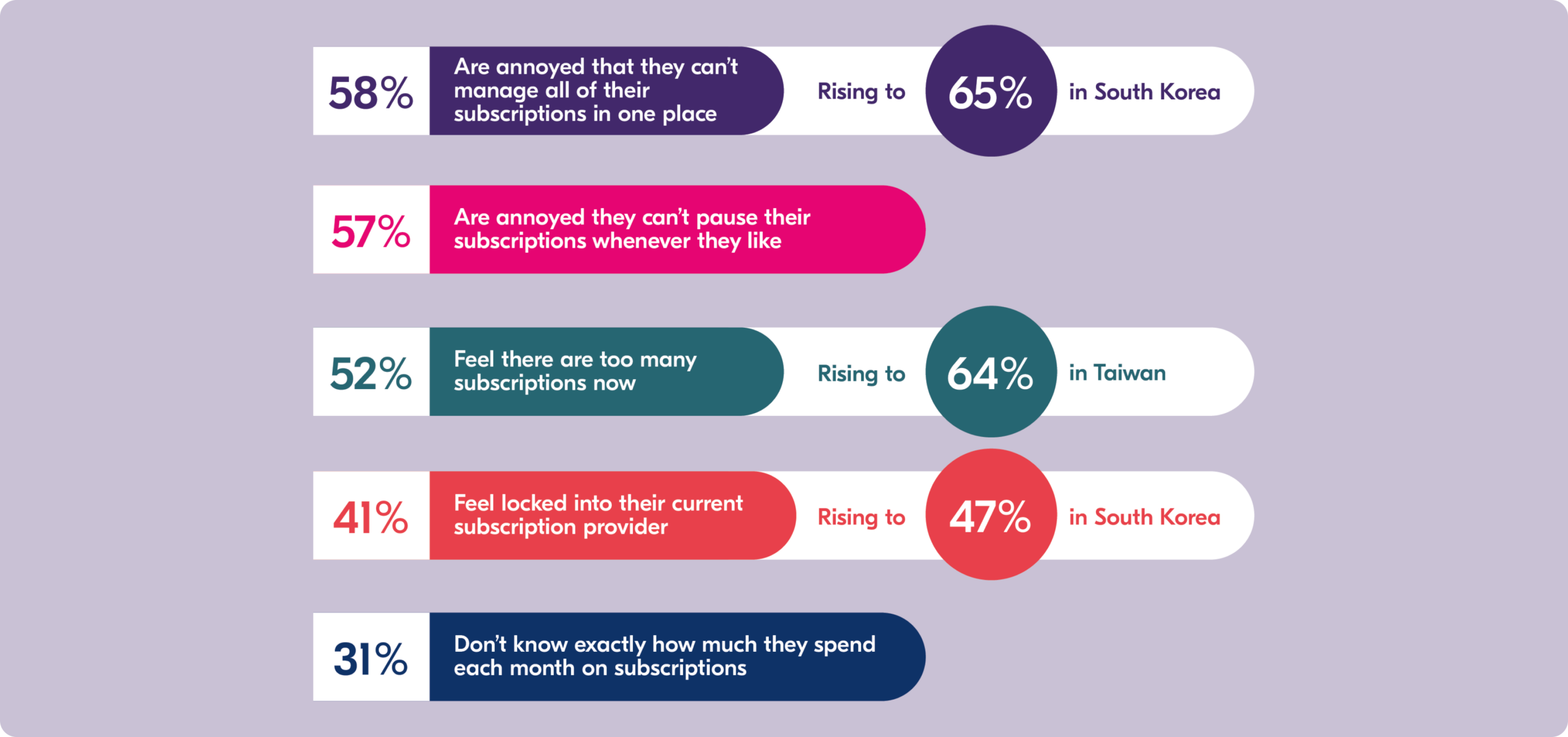
Despite the strong demand for subscription services in East Asia, many subscribers are increasingly frustrated by the challenges of managing their various subscriptions. The complexity of handling multiple services – both local and international – has left users struggling to keep up with billing, contract renewals, and account management.
In fact, almost a third (31%) of subscribers report difficulty renewing their subscriptions or paying their bills, while 25% have trouble managing and updating personal details.
Beyond billing issues, users also face obstacles when trying to switch between accounts (23%) or access services across multiple devices (23%), making the overall experience cumbersome.
Even seemingly simple tasks, such as remembering where they signed up for a free offer (17%) or setting up new subscription apps (15%), add to the frustration. These barriers not only impact the user experience but also contribute to subscription fatigue as consumers find it increasingly difficult to manage their digital services.
Offering simplified, flexible subscription management solutions, along with more transparent pricing and content bundling, will be essential for content providers and subscription services who want to meet the evolving needs of subscribers.
Across East Asia:
Subscribers have experienced difficulty when…
- 31% – Renewing their contract or subscription
- 31% – Paying their bill
- 25% – Managing and updating personal details
- 23% – Switching between accounts
- 23% – Accessing accounts across multiple devices
- 17% – Remembering where they signed up to a free offer
- 15% – Setting up new subscription apps
- 15% – Canceling their subscription
- 11% – Setting up additional plans or group accounts (e.g. family plans)
4. Indirect subscriptions and the rise of content hubs
As East Asian subscribers look for greater choice and flexibility, a shift towards indirect subscriptions is taking place. More than a third of subscribers (34%) now choose to sign up exclusively via third-party bundles and offers, a much higher rate than in the USA, Europe, or Latin America. In Japan, nearly 40% of subscribers select subscriptions from indirect channels.
This trend reflects the growing appeal of indirect channels, where consumers can access better deals, greater flexibility, and more convenient ways to manage their subscriptions more cheaply. Bundling through telcos and other third-party providers has become vital for consumers looking to streamline their subscription services without being locked into rigid, direct sign-ups.
Local market leaders are already innovating: South Korea’s SK Telecom launched its T Universe subscriptions hub in 2021 and LG U+ launched Udok in 2022. But subscribers across the wider region still want more.
Outside East Asia, content hubs like Verizon +play in the USA and Optus SubHub in Australia have set a new standard by offering all-in-one platforms where users can manage multiple subscriptions, such as streaming services, seamlessly.
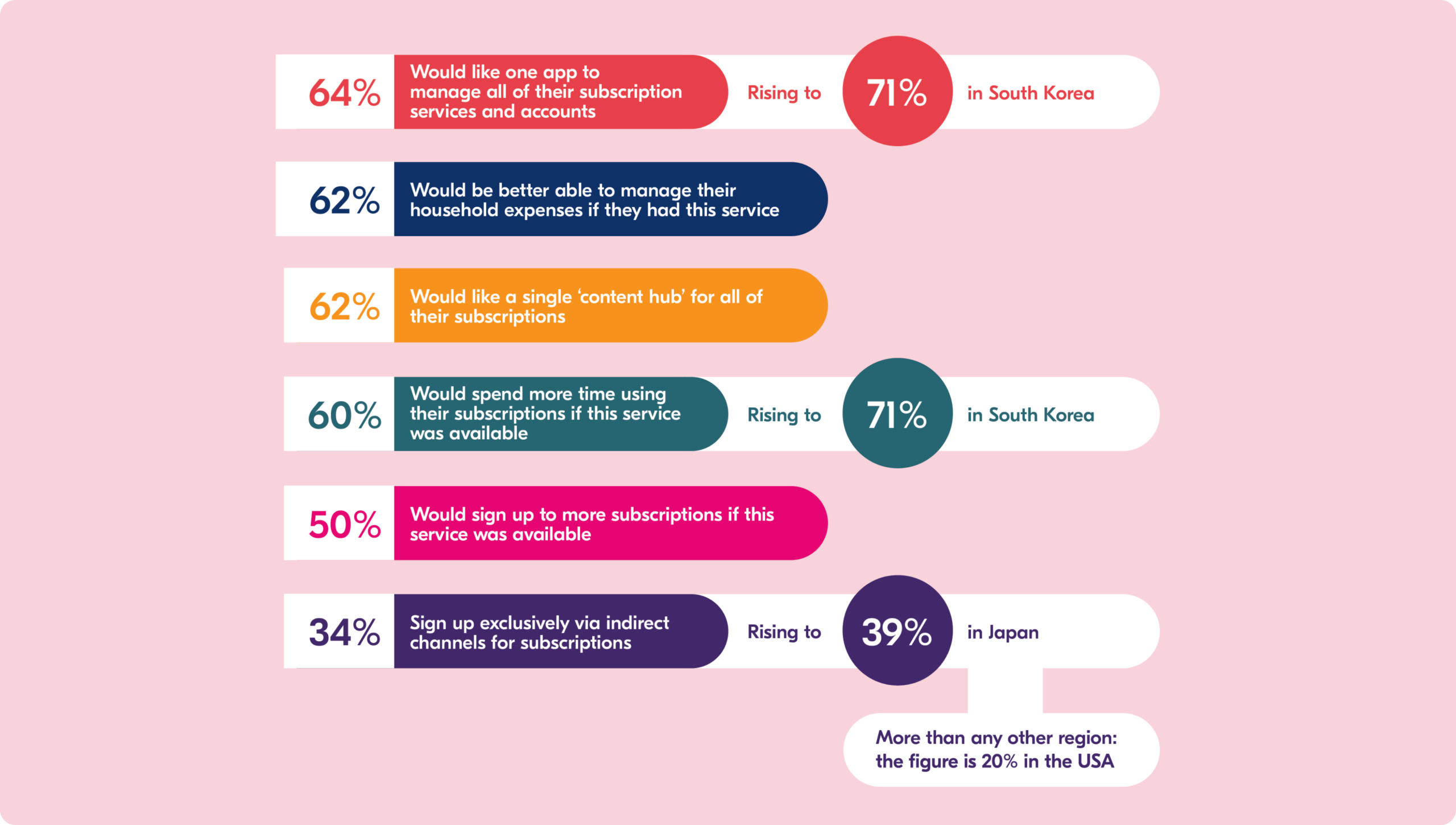
As complexity increases, East Asian subscribers are calling for similar content hubs to simplify their experience and control their expenses. The introduction of such platforms could not only meet this demand but also reshape the subscription landscape, providing the ultimate solution for managing an ever-expanding range of services.
Features East Asia subscribers want from all-in-one subscription platforms:
Subscribers want more choice, control and flexibility
5. Super Bundling: Telcos take control
Subscribers throughout our survey have made it clear that they want more than just content hubs – they want telcos to take the lead in delivering these services, and they’re willing to pay for it.
Ultra-fast 5G means that mobile is already the key gateway for content, and telcos already have trusted billing relationships with consumers. So it’s no surprise that two-thirds (66%) of subscribers specifically want mobile providers to lead on the creation of centralized content hubs. This demand is higher than in the USA (50%), Europe (46%), or Latin America (55%).
Telco-driven bundling is already an integral part of the subscription landscape in East Asia. In Japan, KDDI offers bundles that include Amazon Prime, YouTube Premium and Netflix, while SK Telecom in South Korea has long offered Wavve (local) and Apple TV+ as part of its bundle deals. However, these offerings remain somewhat fragmented, and subscribers are asking for a more unified solution.
Super Bundling is the key to solving this. By creating all-in-one content hubs, telcos can integrate multiple services into a seamless experience, addressing the complexity, billing issues, and management frustrations voiced by subscribers. This would not only enhance customer satisfaction but also strengthen the telcos’ position as the central players in the East Asian subscription market.
Who do East Asia subscribers want to provide an all-in-one subscription service?
Key statistics | East Asia | Japan | South Korea | Taiwan |
Mobile Operator* | 66% | 65% | 64% | 70% |
Payment or wallet company | 24% | 21% | 24% | 32% |
Broadband provider* | 23% | 18% | 23% | 33% |
Banks or credit unions | 18% | 12% | 21% | 26% |
A social media platform | 14% | 9% | 14% | 24% |
Retailer | 11% | 6% | 12% | 18% |
TV, satellite or cable provider* | 10% | 13% | 6% | 12% |
Employer or employee benefits company | 5% | 3% | 4% | 9% |
*Telco provided services
Super Bundling: Subscribers describe how they would respond to all in one Content Hubs
Would be more loyal to a brand that provided an all-in-one service
Would be more likely to recommend a brand that provided an all-in-one service
Would leave their current telco provider if this service was offered elsewhere (rising to 53% in South Korea)
Would be open to paying a higher internet/mobile bill if a package of popular subscriptions was included (rising to 47% in South Korea)
The average subscriber would be open to paying a 16% higher bill if they could manage their subscriptions via a single platform (rising to 22% in Taiwan)
Would be open to pay an extra 25%+ if they could access and manage their subscriptions via a single platform
Taiwan is the most likely to want a social media platform to offer this service (compared to just 9% in Japan and 21% in South Korea)
Taiwan is also the most likely to want a bank to offer this service (compared to just 12% in Japan and 21% in South Korea)
Section 2: State of the nation – Subscription trends per market
Japan
Japan is the most advanced subscription economy when it comes to where subscriptions are bought with 39% buying exclusively indirectly – where once subscriptions were always direct-to-consumer. This is an emerging global trend, highest in Japan, versus as an example of USA 20%.
Japan’s subscription market is diverse, but heavily skewed towards video streaming, with SVOD topping the list of most popular subscriptions by a considerable margin. 75% of Japanese subscribers have at least one SVOD subscription, followed by music (34%) and an emerging interest in retail and food boxes (25% and 24% respectively).
On average, Japanese subscribers hold around 3 subscriptions, paying 3,188 JPY ($22) per month, or 38,256 JPY ($272) annually.
Despite the variety of services, many Japanese consumers struggle to manage their subscriptions. A significant 53% are frustrated with the difficulty of managing multiple services, while 31% admit to losing track of their subscription spending.
Affordability is a major issue in Japan, with 68% of subscribers unable to afford all the services they want – the highest in the region. This has led 31% of subscribers to cancel at least one service due to price increases.
There’s also growing demand for a unified solution, as 56% of subscribers want one app to manage all of their services, and 23% would be willing to pay more for their internet or mobile bill if telcos provided such a service.
Most popular subscriptions in Japan
Average number of subscriptions – 2.8/person
Average subscriber pays 3,188 JPY – $22/month
Average subscriber pays 38,256 JPY – $269/year
Quick facts:
- 68% – Can’t afford all the subscription services they want — more than any other market in the region
- 56% – Want one app to manage all of their subscription services in one place
- 53% – Are annoyed they can’t manage all of their subscriptions in one place
- 39% – Go exclusively indirect for subscriptions – more than any other market across East Asia, LATAM (21%), USA (20%) and European (30%) reports
- 31% – Have canceled a subscription due to a price increase
- 31% – Have lost track of their subscription spending
- 23% – Would pay a higher internet or mobile phone bill to any telco that provided this service
South Korea
South Korea’s subscription market is vibrant, with the average subscriber holding 3.4 subscriptions and spending around 39,963 KRW ($30) per month, or 479,556 KRW ($363) annually.
SVOD dominates the market at 84%, while music subscriptions follow at 49%. Retail subscriptions are also a significant player at 46%, alongside food boxes (18%) and gaming services (15%). Despite the broad adoption across various categories, the complexity of managing multiple subscriptions has emerged as a major pain point for South Korean consumers.
A notable 65% of subscribers are frustrated by their inability to manage all of their services in one place, the highest in the region. This has driven 71% to call for a unified app to centralize their subscriptions.
Affordability is a growing concern, with 62% stating they can’t afford all the services they want, and 42% – the highest rate in this report – have canceled a subscription due to price hikes. Despite these challenges, there is significant potential for telcos to step in, as 47% of South Korean subscribers are willing to pay more for their internet or mobile bill if it includes a comprehensive subscription management service, again leading the region in this demand.
Most popular subscriptions in South Korea
Average number of subscriptions – 3.4/person
Average subscriber pays 39,963 KRW – $30/month
Average subscriber pays 479,556 KRW – $363/year
Quick facts:
- 71% – Want one app to manage all of their subscription services in one place – more than any other East Asia market in our sample
- 65% – Are annoyed they can’t manage all of their subscriptions in one place – more than any other East Asia market in our survey
- 62% – Can’t afford all the subscription services they want
- 47% – Would pay a higher internet or mobile phone bill to any telco that provided this service
- 42% – Have canceled a subscription due to a price increase – more than any other market in our East Asia survey
Taiwan
Taiwan leads East Asia in subscription adoption, with the average subscriber holding 4.2 subscriptions and spending 1,124 NTD ($35) per month, or 13,488 NTD ($420) annually. SVOD services top the table, subscribed to by 76% of users, followed closely by retail and music services, each at 43%.
Gaming is another key player, capturing 42% of subscribers – more than in any other region – while news services account for 17%. Despite high engagement, managing this variety of subscriptions has become increasingly complex for consumers.
Over half of Taiwan’s subscribers (53%) are frustrated by the difficulty of managing multiple services, and 29% have even lost track of their spending. The need for simplification is clear, with 66% calling for a unified app to handle all their subscriptions.
Affordability remains a challenge for 51% of subscribers, and 35% have canceled services due to price increases. Despite these frustrations, 47% are willing to pay more on their mobile or internet bill if a telco could offer an all-in-one solution to manage their subscriptions.
Most popular subscriptions in Taiwan
Average number of subscriptions – 4.2/person
Average subscriber pays 1,124 NTD – $35/month
Average subscriber pays 13,488 NTD – $420/year
Quick facts:
- 66% – Want one app to manage all of their subscription services in one place
- 53% – Are annoyed they can’t manage all of their subscriptions in one place
- 51% – Can’t afford all the subscription services they want
- 47% – Would pay a higher internet or mobile phone bill to any telco that provided this service
- 35% – Have canceled a subscription due to a price increase
- 29% – Have lost track of their subscription spending
Super Bundling: Where do I start?
Content providers
Super Bundling gives content providers instant access to a ready-made distribution, marketing and billing network offered by telcos and other channels around the world. Bringing together telcos and content providers in one place, the Digital Vending Machine® from Bango is a SaaS product that enables the Super Bundling of content subscriptions.
Several global telcos have already created their own vibrant content hubs – bringing together dozens of providers including Netflix, ESPN, Amazon Prime, Duolingo, YouTube, Peloton, Audible and more in one seamlessly integrated solution.
The Digital Vending Machine® from Bango isn’t just for established players. The low barrier to entry means it’s ideal for content and service providers looking to make a name for themselves. Plus, it opens doors to some of the biggest reseller networks around including telcos, banks and retailers. Support for a range of commercial models means that the Digital Vending Machine® from Bango ensures you get to market at speed and with minimal integration pain.
Telcos
The Digital Vending Machine® from Bango is loaded with pre-built integrations for hundreds of subscription products, apps, and streaming services. We provide all the core requirements via standardized technology enabling telcos to deliver Super Bundling in months, rather than years.
The Digital Vending Machine® from Bango is available as a SaaS product, which means telcos can quickly and easily scale, gaining access to a constantly evolving and growing ecosystem of global subscription and content providers.
This happens through a single one-tomany integration, avoiding time-consuming one-to-one arrangements. Enabling this super-fast time to market means that telcos can focus on the things that matter most to them: customer acquisition, retention and engagement. Developing subscription hubs with Verizon and Optus, we’ve helped create deals spanning Netflix, ESPN, Amazon Prime, Duolingo, YouTube, Peloton, Audible and more.
The Digital Vending Machine® from Bango brings together resellers and content providers to enable Super Bundling of subscriptions at speed and scale.