
Subscriptions Assemble: Welcome to the bundle economy
A new era…
A new era…For years, the Subscription Wars raged on, with streaming giants and digital services battling for subscribers. From video streaming to gaming platforms, financial apps to fitness trackers, the competition has been fierce. Each provider has been fighting to win and keep subscribers in an increasingly fragmented market.
But in 2025, things are changing. A new force is reshaping the battlefield, turning rivals into allies and competition into collaboration. The subscription economy is evolving into something more powerful, more sophisticated, and ultimately more lucrative – the bundle economy.
The smartest players aren’t simply competing anymore. They’re assembling. Paramount+ and Apple TV+ aren’t just battling Amazon Prime Video – they’re bundled with it, sharing a home with competitors. Subscribers are not simply loyal to a single direct provider. They’re chasing the best offers, signing up in entirely new, unpredictable ways and embracing flexibility and control.
More than two-thirds of subscribers (68%) have taken an indirect subscription buying via a bundle or third-party channel. That’s a seismic shift that’s turning competing subscription providers into team players in a much bigger game.
So what does the future look like? What do subscribers want in 2025? And how are telcos, resellers, and subscription providers making the most of the bundle economy? Read on to find out.
Methodology
This report includes data from 5,000 US subscribers, exploring their attitudes, behaviors, and the transition from the subscription to the bundle economy.
Commissioned by Bango and conducted by independent research agency 3Gem, the Subscriptions Assemble research was conducted in January 2025 and launched in March 2025.
In this report, you’ll discover
- How the subscription wars gave way to the bundle economy
- Why subscribers are going indirect
- How subscribers are becoming smarter about their subs
- Why subscription fatigue continues to drive demand for Super Bundling
- Who stands to gain in the bundle economy
1. Welcome to the bundle economy
The Subscription Economy is at a turning point.
Once, Americans subscribed directly – signing up to Netflix via netflix.com. Today, that’s changing. The average US subscriber pays for 5.4 subscriptions – but 2 are indirect, acquired through bundles and third-party channels.
5.4 – The Average US subscriber has 3.4 direct and 2 indirect subscriptions
That’s a landmark shift, with collaboration, not competition, becoming the name of the game.
Just look at the streaming landscape. Paramount+ is now available through Amazon Prime Video. Disney+ sits alongside travel and groceries in UberOne. Netflix and Max peacefully coexist, sold together as a hard bundle, on Verizon’s myPlan and +play.
$900 – Average US subscriber spend per annum on subscriptions – 23% pay over $1200
So much for the streaming ‘wars’.
As subscribers seek out simplicity and consolidation, subscription services are now looking for opportunities to collaborate and grow through indirect channels. The lucrative subscription economy is evolving into a bundle economy, where success – and future growth – means being part of something bigger.
Subscription adoption by category
The social generation
Nearly a quarter (23%) of 18-25 year-olds pay for a subscription to a social platform like X, rising to 27% of 25-34 year-olds. This age group is also most likely to pay for an AI subscription, with 18% signing up to a service like ChatGPT Pro.
All subscriptions by all generations
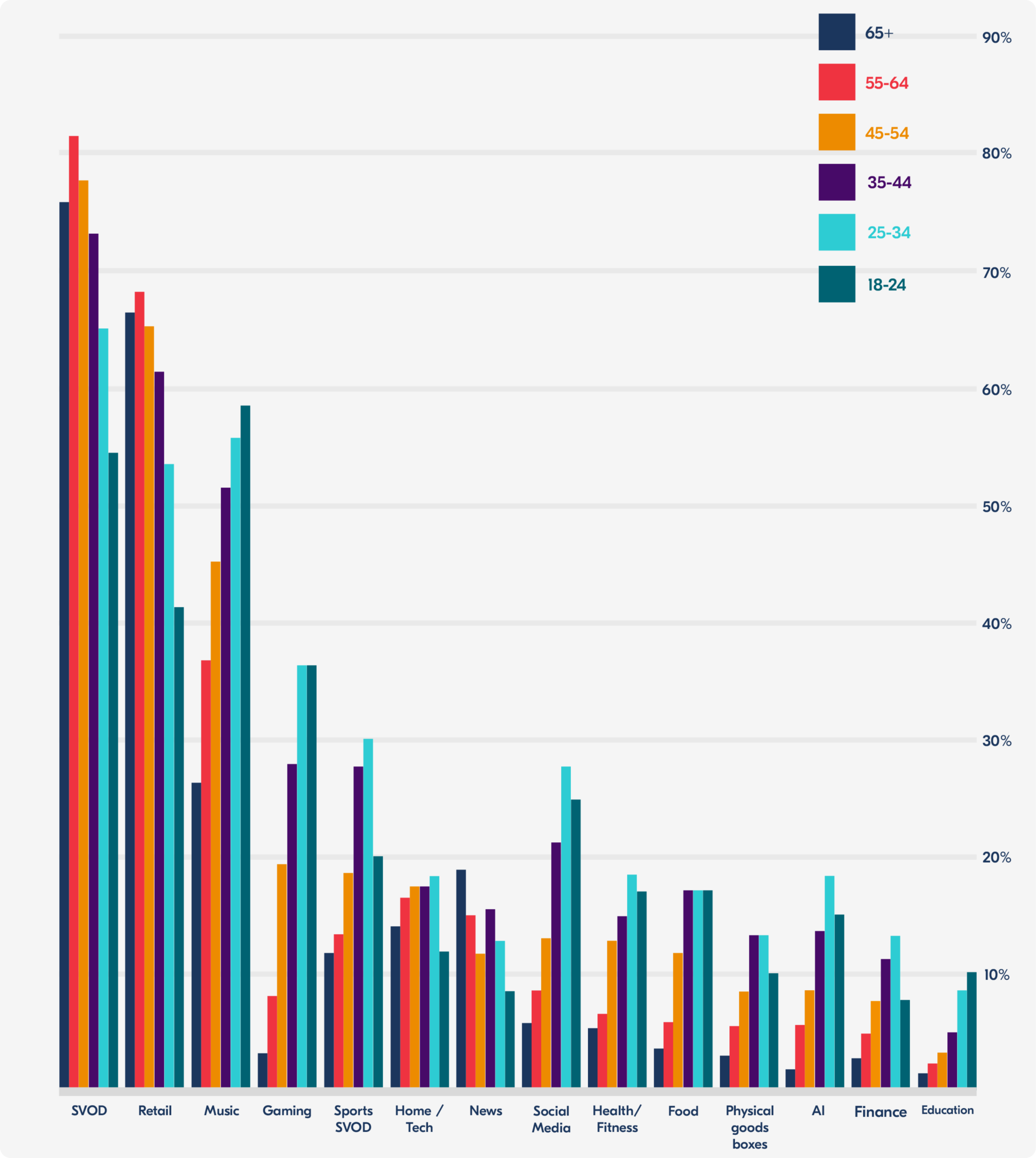
Top subscription types by generation
18-24
25-34
35-44
45-54
55-64
65+
2. The future is indirect
Subscribers are finding smarter, more flexible ways to access the content they want.
Whether through a telco plan, a retail bundle, or a bank loyalty scheme, signing up to subscriptions indirectly is now mainstream. More than two-thirds (68%) of US subscribers now pay for at least one subscription indirectly.
of US subscribers have an indirect subscription
For subscribers, this move is about convenience, experience, and price.
Nearly 1 in 3 US subscribers (28%) believe they get a worse deal when subscribing directly, a number that climbs to 41% among those under 35. With young consumers driving this trend, direct sign-ups are rapidly being replaced by smarter, bundled alternatives.
Amazon Prime Video is the perfect example of this kind of smart alternative.
Rather than directly competing with dozens of alternative streaming services, Amazon has made many of these subscription services available through its own Prime Video service. The result is a more flexible and seamless experience for customers, as well as the opportunity for platforms like Paramount+, Discovery+ and Apple TV+ to reach an entirely new subscriber base.
of US subsribers would prefer a bundle instead of buying multiple individual subscriptions
The ten most popular Amazon Prime Video add-ons
From a list of 35 top subscription services offered in Amazon Prime Video
Flexible first
Flexibility is another major reason why subscribing indirectly is on the rise.
Many subscribers are frustrated with rigid subscription models that don’t adapt to their needs. On the hunt for greater flexibility, 62% of US subscribers say they’d rather have a bundle than sign up for individual services.
80% say they would prefer to pick and choose which subscriptions are included in that bundle, rather than being forced into pre-set packages.
Value is also a factor, with 44% of subscribers getting a subscription they used to pay for free of charge, thanks to a bundle deal. Among 18-24 year-olds, this jumps to 55%!
Why do subscribers sign up indirectly?
Where are subscribers getting these bundles?
Cell phone providers are the largest indirect subscription channel, with 55% of subscribers receiving at least one subscription through their provider. Half (49%) also argue these subscriptions aren’t just a “perk”, they’re essential services in their lives.
Retailers, broadband companies, and even payment platforms are also joining the bundle economy, giving consumers ever more ways to subscribe.
Resellers are at a crucial point where if they don’t act fast and enable their own distribution channel, subscribers may go elsewhere.
Where do Americans get their indirect subscriptions from?
- Cell phone providers – 55%
- Retailers- 34%
- TV, satellite or cable providers – 25%
- Payment or wallet companies – 23%
- Social media – 19%
- Broadband providers – 19%
- Banks – 12%
- Connected TVs – 7%
- Utility providers – 7%
- Employer – 5%
3. Smarter subscribers
The shift to indirect subscribing comes as part of a wider change in how America buys and uses subscription services.
Today’s subscribers are smarter than ever. Rather than committing to long-term subscriptions, many are rotating between services, signing up only when needed. Just look at the video streaming space, where 1 in 7 subscribers (14%) have canceled a service after their favorite show ended.
This subscription savviness may be one factor driving demand for bundles, as subscribers increasingly shop around and search for the best possible deals for them.
For subscription providers, it’s a wake-up call to stay competitive and ensure their services are ‘bundle ready’.
of US subscribers now shop around for the best deal before signing up
of US subscribers use an app, website or browser to find subscription deals
of US subscribers frequently pause and restart subscription services
Do subscribers frequently pause and restart subscriptions?
Forever subscriptions
Despite many subscribers jumping between different services, 70% have one subscription that they will never cancel or even pause. This rarefied status of the ‘Forever Subscription’ represents the ultimate goal for content providers looking to land a lifetime subscriber.
4. Subscription fatigue drives Super Bundling
Subscribers may be getting better deals through bundles and indirect sign-ups, but many of their favorite subscriptions are still spread across different platforms, providers, and payment methods.
The result? Subscription fatigue.
can’t afford all the subscriptions they want
are annoyed they can’t manage all their subscriptions in one place
can’t remember how they originally signed up
find it too hard to keep track of their subscriptions
don’t know how much they spend on subscriptions
pay for a subscription they’re not using – rising to 46% for 18-24 year-olds
Subscribers aren’t overloaded – if anything they want more subscriptions. The problem is that their subscription experience has become disjointed and difficult. That’s why nearly two-thirds of subscribers (63%) now want one app to manage all of their subscriptions.
This is where the bundling reaches its ultimate form – Super Bundling.
Rather than simply offering a handful of subscriptions, Super Bundling allows telcos, banks and other resellers to create a central hub for dozens of subscriptions. Most importantly, it provides subscribers with an easy way to pay for and manage all of these services.
Super Bundling is the key to unlocking the bundle economy. It shifts ownership of subscriptions from the provider to the subscriber, providing flexibility and control.
Platforms like Verizon +play in the US and Optus SubHub in Australia are already leading the charge, but with the majority of subscribers demanding this technology, we expect many more brands to follow.
of US subscribers want one app to manage all of their subscriptions
5. Who will lead the bundle economy?
Telcos have long been the go-to choice for subscription bundling, leaning on their strong existing billing relationships with customers.
Now in 2025, the bundle economy is expanding. Financial companies, retailers, and even social media platforms are getting in on the action.
Traditional retailers, such as Walmart and Costco, are already incorporating streaming and lifestyle services into their membership programs.
Payment providers, wallets and banks are motivated to use bundling to acquire and retain customers, and drive frequent usage of their apps.
Social media platforms may be next. Currently these services have largely been included within bundles, with the likes of Snapchat+ accessible via Verizon +play. In future however, social media companies could grow their user base through bundles of their own, with 1 in 5 under 35s wanting their subscriptions managed by a social giant like Meta, TikTok, or X.
And of course, as the gateway to so much streaming video and gaming, Connected TV is a natural home for subscription bundling. Whatever space it’s in, brands that simplify subscriptions and put subscribers in control will ultimately win loyalty. The bundle economy is booming, and it’s crying out for someone to lead the way.
would spend more time using subscriptions if a single hub was available
would sign up to more subscriptions if they could manage them in one place
of subscribers would be more loyal to a brand that provides Super Bundling
would recommend a provider offering this service
Who do subscribers want to offer a single platform for subscriptions?
Win, win, win
The Subscription Wars are over. The bundle economy is here, transforming competition into collaboration and creating win-win-win opportunities for subscribers, content providers, and resellers alike.
For subscribers, the days of fragmented services and scattered billing are coming to an end. Super Bundling gives consumers more choice, better pricing, and seamless management, allowing them to access multiple services in one place, on their own terms.
For content providers, bundling isn’t just about distribution – it’s about expansion. By partnering with resellers, services can reach new audiences and drive higher engagement and retention, without typical payment blockers.
For resellers, the opportunity is even greater. Telcos, banks, and retailers are moving beyond their core businesses to become subscription hubs, offering customers integrated bundles that increase loyalty, drive spending, and unlock new revenue streams.
With more than two-thirds of subscribers now choosing indirect access to services, the shift is undeniable.
Super Bundling is not just the future – it’s happening now. Our data shows that consumers want a single destination to subscribe, manage, and pay for their services. But this is just the beginning.
For content providers and resellers, the path forward is clear: those who simplify subscriptions, give subscribers control, and embrace bundling will lead in the new bundle economy. Whether you’re a subscription provider or a reseller, the chance to shape the future of how the world subscribes is now.
Where do I start?
Content providers
Super Bundling gives content providers instant access to ready-made distribution, marketing, and billing networks offered by telcos, ISPs, retailers, banks, and more. The Digital Vending Machine® (DVM™) from Bango is the fastest way for content providers to integrate with partner bundles and subscription hubs to reach millions of new subscribers worldwide.
Leading consumer brands use the DVM to deliver everything from innovative customer perks (like Verizon MyPlan) to advanced content hubs (like Optus SubHub) that combine leading brands like Netflix, ESPN, Amazon Prime, Duolingo, YouTube, Peloton and Audible into one seamless experience.
Connecting once to the DVM, content providers become instantly available for leading partners to select and bundle, enabling:
- The bundling standard – a single consistent experience using standardized functionality and automatic updates, across all partners
- New opportunities – it’s easy for partners to discover each other – helping your products reach new customers worldwide
- Active partner growth – insights about activations, engagement, and churn across reseller networks
The Digital Vending Machine® makes it simple for content and service providers of all sizes to partner and deliver bundles, cost efficiently. By connecting once to the DVM ecosystem, it’s quick and easy to unlock a constantly growing partner network proven to drive rapid, global subscriber growth.
The Digital Vending Machine® isn’t just for established brands – its low barrier to entry makes it an ideal platform for emerging content and service providers. By connecting to the DVM ecosystem, providers instantly unlock access to a global reseller network, including telcos, banks, and retailers – driving rapid subscriber growth with minimal integration pain.
Resellers
The Digital Vending Machine is pre-loaded with connections for hundreds of subscription products, apps, and streaming services. As a SaaS product, the DVM allows telcos, banks, and retailers to deliver Super Bundling in months, rather than years – eliminating the complexity of building a subscription hub from scratch.
With the latest Bango DVM product release resellers can now:
- Launch a fully branded subscription hub with pre-built templates optimized for desktop and mobile
- Offer & manage sophisticated deals across multiple subscription partners with powerful offer management tools
- Consolidate live subscriptions from existing customers into a seamless Super Bundling hub – without service disruption
- Analyze & optimize performance with real-time data on activations, usage trends, and retention metrics
Digital Vending Machine®
The Digital Vending Machine® transforms the subscription bundling process from a technical challenge into a seamless business opportunity. By leveraging one-to-many integration, resellers gain instant access to a constantly growing ecosystem of global subscription providers — including Netflix, Amazon Prime, Disney+, YouTube Premium, and more.